-
Solo Business Courses
-
 Others
-
Overseas Tutorials
-
Photography & Editing
-
Community & Private Domain
-
Self-Media Writing & Copywriting
-
Side Income Projects
-
E-commerce
-
Short Video & Live Streaming
-
Artificial Intelligence (AI)
-
Software & Tools
-
Operating Systems
-
Plugins & Scripts
-
MacOS Software
-
Android Software
-
Windows Software

2026 AI Real-Person Narration Comic-Drama Automated Batch Production Tutorial, 40-Minute Full-Length, Auto Batch Production, Challenging One Person, One Drama a Day!
-
Game Gold-Farming Money-Making Plan: Earn 1k+ Daily, a Stable 3-Year Project Anyone Can Do in Spare Time [Revealed]
Study material — included with membership Get Membership -
Hot-game fully-automated earning: 500+ a day, no experience, simple operation - the steadiest long-term game-earning side hustle (revealed)
Study material — included with membership Get Membership -
FlyingMouse earns merit this time! Don't panic at Windows format problems — the open-source FlyingMouse format conversion tool helps, a popular GitHub gem
Study material — included with membership Get Membership -
Douyin Product-Selling Coaching Bootcamp: No On-Camera Appearance Needed, Newbies Can Produce Selling Short Videos by Following the Steps
Study material — included with membership Get Membership -
First-release game gold-farming money plan: 1K+ a day, ordinary people in spare time
Study material — included with membership Get Membership






-
FlyingMouse earns merit this time! Don't panic at Windows format problems — the open-source FlyingMouse format conversion tool helps, a popular GitHub gem
Study material — included with membership Get Membership -
LuDaShi v6.1024.4105.1121 Slim Single File
Study material — included with membership Get Membership -
2D Cartoon Animation Software Moho Pro v14.3
Study material — included with membership Get Membership -
Video Editor Aiseesoft Filmai v1.0.18
Study material — included with membership Get Membership -
To-Do Microsoft To Do v2.147 Free
Study material — included with membership Get Membership -
PR/AE/DaVinci/FCPX video Plugin Nobe OmniScope Win1.11.15 / Mac1.10.138
Study material — included with membership Get Membership



The tutorial on producing AI real-person narrated slow-drama covers cost control and a batch automation workflow, with the core being low-cost, high-efficiency production through open-source or closed-source models. The steps are: write the script, storyboard inference, set characters and style, batch drawing/voiceover/animation, and finally import into JianYing to compose. Cost can be as low as 1-3 yuan per minute; the key depends on the story content rather than picture quality, and it suits batch unattended running.
Section Summary
00:01
Wireless Canvas and Open-Source Models
1. Wireless Canvas can produce premium comic dramas, including characters, scenes, voiceover and video.
2. Wireless Canvas is more expensive than open-source models because it uses edge-computing models, with higher compute costs.
3. Open-source models are cheaper, only 3-5 yuan per minute.
00:45
AI Real-Person Narration Drama Production Tutorial
1. The tutorial has five parts: case demo, market analysis, production-tool selection, concrete production steps, and cost analysis with advice.
01:07
Case Demo
1. Case 1: Shen Zhaoning, the legitimate eldest daughter of the Shen Manor, reborn for revenge.
2. Case 2: Shen Zhaoning reborn for revenge (four-panel + group model).
3. Case 3: Shen Zhaoning reborn for revenge (Wireless Canvas).
02:49
Market Analysis
1. After April 30, the slow-drama market changed a lot, and monetization became harder.
2. Premium comic dramas and narrated slow-dramas polarize into two extremes.
3. Narrated slow-dramas cost little, just 2-3 yuan per minute.
4. Narrated slow-dramas rely on low-price batch content; content quality is not the focus.
03:48
Choosing Production Tools
1. Production tools come in open-source and closed-source modes.
2. Closed-source models perform better but are mainly for premium comic dramas.
3. Open-source models are for narrated slow-dramas, with lower cost.
4. Using Wireless Canvas's closed-source model costs more.
5. Lowering resolution and using a workflow to upscale to HD can cut costs.
05:57
Open-Source vs Closed-Source Models
1. Open-source models are cheaper, around 3 yuan per minute.
2. Closed-source models cost more, 6-8 yuan per minute.
3. Open-source models perform no worse than closed-source and suit narrated slow-dramas.
06:05
Concrete Production Steps
1. Write the script: use a large language model to generate it, then polish and refine it.
2. Storyboard inference: use Wanxiang software for storyboard inference, choosing general or director mode.
3. Set characters and style: pick the style, cloud engine and character voice.
4. Batch drawing, voiceover and animation: use the RunningHub workflow for batch processing.
5. Import into JianYing to compose the video: set the JianYing draft location and import the composed video.
25:19
Batch Unattended and Automated Processing
1. Batch drawing: use the RunningHub workflow to draw in batches.
2. Batch voiceover: pick the narration voice and voiceover in batches.
3. Batch animation: use the RunningHub workflow for batch animation.
4. Import into JianYing to compose the video: set the JianYing draft location and import the composed video.
Key Points
RunningHub Wireless Canvas workflow for producing premium episodes
00:01
Cost analysis of Wireless Canvas
03:42
Script generation and storyboard script production
15:34
Generating character-design, scene and prop images
17:57
Designing voice timbre
19:58
Batch animation
21:13
*Note: This article is for introduction only and does not constitute any income promise; monetization results vary from person to person and require your own effort and practice. Use what you learn reasonably, and strictly abide by platform rules and relevant laws and regulations.*
Supporting Study Materials
This course comes with a materials pack. Members receive the access link by email after requesting the course.
Related Courses

Family Comedy Short-Drama Creation Course: Benchmark Hot Accounts, AI-Assisted, Fast Start for Total Beginners, Grow Followers and Drive Product Sales

Amazon AI Automation Practical Course: AI Operating Mindset, Setting Up the Codex Environment, Risk-Control Checks and Automated Listing Copy

AI E-Commerce Data Tool Development Course: Learn Codex+BI From Zero, Build a Multi-Store Integrated Visualization Dashboard


Advanced AI Prompt Application: 15 Lessons | Universal Instruction Thinking + Multiple Output Modes + Full Industry Commercial Cases
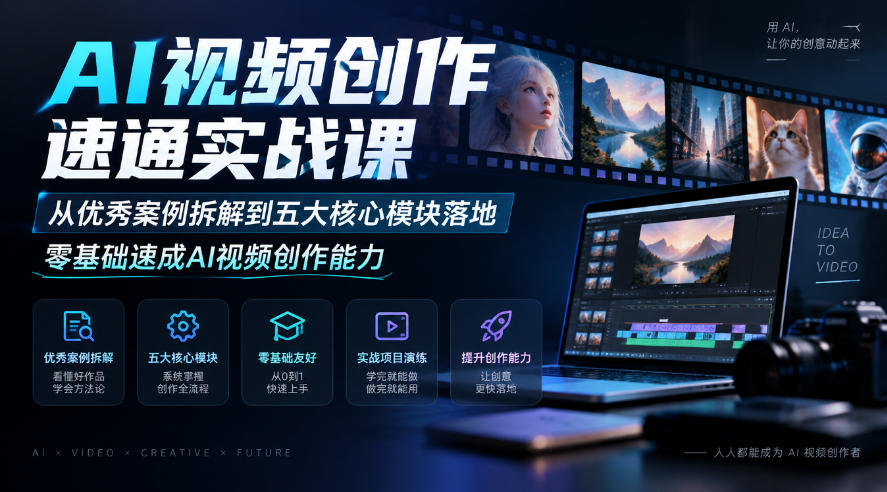
AI Video Creation Crash Course: From Great-Case Breakdown to Five Core Modules, Fast-Track AI Video Skills for Total Beginners

AI Commercial Practice System Course: In-Depth SD Mastery + Advanced Flux Hands-On + Comfyui Workflow Building, Full Commercial Design Project Training

[National-Day Pick] AI Automation Game, 1k+ RMB a Day, Simple to Operate, Stable for Three Years! [Revealed]