-
Solo Business Courses
-
 Others
-
Overseas Tutorials
-
Photography & Editing
-
Community & Private Domain
-
Self-Media Writing & Copywriting
-
Side Income Projects
-
E-commerce
-
Short Video & Live Streaming
-
Artificial Intelligence (AI)
-
Software & Tools
-
Operating Systems
-
Plugins & Scripts
-
MacOS Software
-
Android Software
-
Windows Software

Director-Level Creation Practical Course for AI Comic Drama: Full-Pipeline Systematic Teaching of Prompt Engineering, Shot Language, Dynamic Storyboard, AI Video Generation and Professional Editing
-
Game Gold-Farming Money-Making Plan: Earn 1k+ Daily, a Stable 3-Year Project Anyone Can Do in Spare Time [Revealed]
Study material — included with membership Get Membership -
Hot-game fully-automated earning: 500+ a day, no experience, simple operation - the steadiest long-term game-earning side hustle (revealed)
Study material — included with membership Get Membership -
FlyingMouse earns merit this time! Don't panic at Windows format problems — the open-source FlyingMouse format conversion tool helps, a popular GitHub gem
Study material — included with membership Get Membership -
Douyin Product-Selling Coaching Bootcamp: No On-Camera Appearance Needed, Newbies Can Produce Selling Short Videos by Following the Steps
Study material — included with membership Get Membership -
First-release game gold-farming money plan: 1K+ a day, ordinary people in spare time
Study material — included with membership Get Membership






-
FlyingMouse earns merit this time! Don't panic at Windows format problems — the open-source FlyingMouse format conversion tool helps, a popular GitHub gem
Study material — included with membership Get Membership -
LuDaShi v6.1024.4105.1121 Slim Single File
Study material — included with membership Get Membership -
2D Cartoon Animation Software Moho Pro v14.3
Study material — included with membership Get Membership -
Video Editor Aiseesoft Filmai v1.0.18
Study material — included with membership Get Membership -
To-Do Microsoft To Do v2.147 Free
Study material — included with membership Get Membership -
PR/AE/DaVinci/FCPX video Plugin Nobe OmniScope Win1.11.15 / Mac1.10.138
Study material — included with membership Get Membership



Most AI comic-drama creators today stay at the basic stage of simply generating frames and splicing videos; they don't understand shot staging, can't design dynamic storyboards, their camera movement is stiff, story pacing is chaotic, and character-scene styles are disjointed. Their work is highly homogeneous, has no cinematic texture, and it's hard to produce high-completion, high-like hit content. The core of truly quality comic drama lies not in AI generation tools, but in director-level creative thinking + a standardized production process + refined, practical techniques.
This director-level AI comic-drama practical course breaks the fragmented teaching model and builds a four-stage progression system from basic understanding to full-project delivery, fully adapting professional film shot language, storyboard thinking and camera-movement composition logic to AI comic-drama creation, hands-on guiding you to build a reusable, batch-output professional comic-drama production workflow, thoroughly widening the gap with ordinary creators.
This director-level AI comic-drama practical course breaks the fragmented teaching model and builds a four-stage progression system from basic understanding to full-project delivery, fully adapting professional film shot language, storyboard thinking and camera-movement composition logic to AI comic-drama creation, hands-on guiding you to build a reusable, batch-output professional comic-drama production workflow.
Suitable For
Zero-based beginners entering AI comic drama, comic-drama creators who want to improve work texture, self-media people who want to systematically learn AI video production, content bloggers lacking storyboard/camera-movement thinking with highly homogeneous work, and side-hustle entrepreneurs who want to build a standardized AI creation workflow.
Course Catalog
01. [Stage 4] Standardized Full-Process Basic Theory Lesson for AI Short-Video Creation
02. [Stage 4] Step 2 Asset Generation Practice — Turn Roles and Scenes in the Script into Video Material Assets
03. [Stage 4] Step 3 Storyboard Script Practice — Turn the Script into a Storyboard Script
04. [Stage 4] Step 4 Video Generation Practice Lesson 1 — From Storyboard Script to Generating the 1st Video
05. [Stage 4] Step 4 Video Generation Practice Lesson 2 — From Storyboard Script to Generating the 2nd Video
06. [Stage 4] Step 4 Video Generation Practice Lesson 3 — From Storyboard Script to Generating the 3rd Video
07. [Stage 4] Step 4 Video Generation Practice Lesson 4 — Generate All Remaining Videos from the Storyboard Script
08. [Stage 4] Step 5 Editing Practice — Cut the Storyboard Videos into a Complete Film
09. [Stage 4] Step 1 Script Generation Practice — Turn Inspiration into a Script
10. [Stage 3] AI Short-Drama Editing Lesson 01 — What Is Editing
11. [Stage 3] AI Short-Drama Editing Lesson 02 — Universal Professional Project Management
12. [Stage 3] AI Short-Drama Editing Lesson 03 — Common Jianying Operations on PC
13. [Stage 2] 01 Chapter 1
14. [Stage 2] 02-00 Chapter 2
15. [Stage 2] 02-01 Practice: Jimeng Interface Introduction
16. [Stage 2] 02-02 Practice: Image-to-Video, First/Last Frame, Smart Multi-Frame Video Generation
17. [Stage 2] 02-02 Practice: Text-to-Video
18. [Stage 2] 02-03 Practice: All-Round Reference Video Generation
19. [Stage 2] 03 Chapter 3
20. [Stage 2] 04 Chapter 4
21. [Stage 2] 05 Chapter 5: Six Core Camera Movements
22. [Stage 2] 06 Chapter 6: Matching Camera Movement with Plot
23. [Stage 2] 07 Chapter 7: Dynamic Composition
24. [Stage 2] 08 Chapter 8: Pitfall-Avoidance Guide and Film Output
25. [Stage 1] 01 — Basic Prompt Engineering for AIGC Video Creation
26. [Stage 1] 04 — Image-to-Image and Asset Production
27. [Stage 1] 05 — Shot Language: Stage the Frame Like a Director
28. [Stage 1] 02 — From Inspiration to Storyboard: The Four-Step Creation Method
29. [Stage 1] 03 — Structure and Writing of Text-to-Image
Supporting Study Materials
This course comes with a materials pack. Members receive the access link by email after requesting the course.
Related Courses

Family Comedy Short-Drama Creation Course: Benchmark Hot Accounts, AI-Assisted, Fast Start for Total Beginners, Grow Followers and Drive Product Sales

Amazon AI Automation Practical Course: AI Operating Mindset, Setting Up the Codex Environment, Risk-Control Checks and Automated Listing Copy

AI E-Commerce Data Tool Development Course: Learn Codex+BI From Zero, Build a Multi-Store Integrated Visualization Dashboard


Advanced AI Prompt Application: 15 Lessons | Universal Instruction Thinking + Multiple Output Modes + Full Industry Commercial Cases
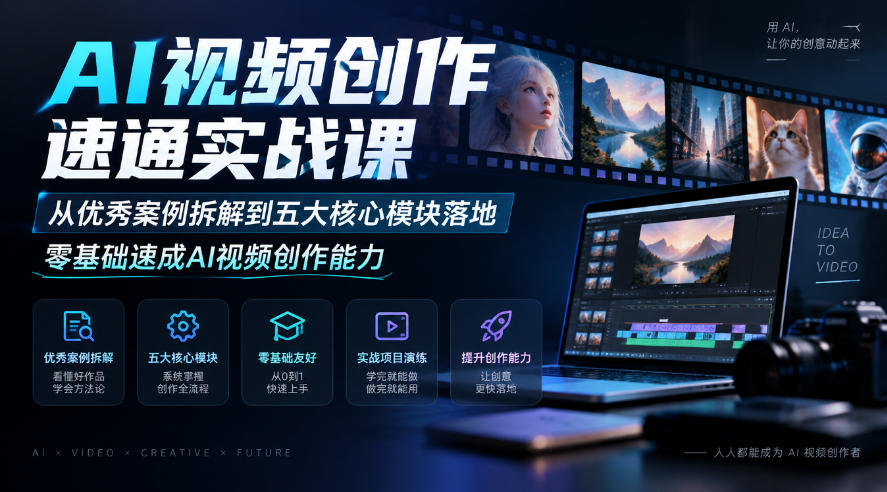
AI Video Creation Crash Course: From Great-Case Breakdown to Five Core Modules, Fast-Track AI Video Skills for Total Beginners

AI Commercial Practice System Course: In-Depth SD Mastery + Advanced Flux Hands-On + Comfyui Workflow Building, Full Commercial Design Project Training

[National-Day Pick] AI Automation Game, 1k+ RMB a Day, Simple to Operate, Stable for Three Years! [Revealed]