-
Solo Business Courses
-
 Others
-
Overseas Tutorials
-
Photography & Editing
-
Community & Private Domain
-
Self-Media Writing & Copywriting
-
Side Income Projects
-
E-commerce
-
Short Video & Live Streaming
-
Artificial Intelligence (AI)
-
Software & Tools
-
Operating Systems
-
Plugins & Scripts
-
MacOS Software
-
Android Software
-
Windows Software


2026 Taobao-Tmall Management Strategy Offline Course: Revealing the A1/A2/A3 Asset Operation Model, the Hit Product Formula, the 3248 Promotion Playbook and the 618 Mega Sale Strategy
-
Game Gold-Farming Money-Making Plan: Earn 1k+ Daily, a Stable 3-Year Project Anyone Can Do in Spare Time [Revealed]
Study material — included with membership Get Membership -
Hot-game fully-automated earning: 500+ a day, no experience, simple operation - the steadiest long-term game-earning side hustle (revealed)
Study material — included with membership Get Membership -
FlyingMouse earns merit this time! Don't panic at Windows format problems — the open-source FlyingMouse format conversion tool helps, a popular GitHub gem
Study material — included with membership Get Membership -
Douyin Product-Selling Coaching Bootcamp: No On-Camera Appearance Needed, Newbies Can Produce Selling Short Videos by Following the Steps
Study material — included with membership Get Membership -
First-release game gold-farming money plan: 1K+ a day, ordinary people in spare time
Study material — included with membership Get Membership






-
FlyingMouse earns merit this time! Don't panic at Windows format problems — the open-source FlyingMouse format conversion tool helps, a popular GitHub gem
Study material — included with membership Get Membership -
LuDaShi v6.1024.4105.1121 Slim Single File
Study material — included with membership Get Membership -
2D Cartoon Animation Software Moho Pro v14.3
Study material — included with membership Get Membership -
Video Editor Aiseesoft Filmai v1.0.18
Study material — included with membership Get Membership -
To-Do Microsoft To Do v2.147 Free
Study material — included with membership Get Membership -
PR/AE/DaVinci/FCPX video Plugin Nobe OmniScope Win1.11.15 / Mac1.10.138
Study material — included with membership Get Membership



1. Course Introduction: The 2026 Taotian Management Strategy Class by Zhizhuan Business is a systematic hands-on course built around Taobao and Tmall store management, asset operation, profit models, product matrices, hit product creation, Wujie promotion and 618 mega sale growth. The course is centered on the shift from traffic dividend to asset dividend. It first explains the 2026 Taotian management trends and, through the A1/A2/A3 store asset diagnostic model, helps merchants identify their store's operating stage and set differentiated profit strategies. It then breaks down the 1×N×M asset operation formula, the 721 product layout, the thousand-people-one-product strategy and a range of hit product matrix combinations, solving problems such as over-reliance on a single hit product, thin profit margins and weak repurchase from existing customers. The practical section focuses on the five-dimension hit product formula, data-driven product selection, precise audience analysis, case reviews of hit products in both standard and non-standard categories, the 3248 execution model for Wujie promotion, the three spending strategies of acquisition, win-back and harvest, and methods for allocating ad budget across stages. Combined with the full 2026 618 mega sale cycle, the course systematically explains pre-event product testing, audience asset accumulation, product layout, promotion rhythm and conversion strategy for the burst phase, helping Taobao and Tmall merchants build a complete management system running from asset diagnosis to profit positioning, product layout, hit product creation, precise advertising, mega sale growth and customer repurchase, boosting store efficiency and long-term profitability. Four core highlights: exclusive asset operation model | hands-on product matrix tactics | full-cycle 618 mega sale strategy | 3248 execution model for Wujie promotion 2. Detailed Course Outline DAY 1|2026 trend awareness and asset diagnosis 1.1 The three generations of e-commerce: traffic operation → audience operation → asset operation 1.2 Core asset operation formula: 1 (person) × N (products) × M (channels) 1.3 Store asset diagnosis: O/A1/A2/A3/P 1.4 Core characteristics and criteria of the A1/A2/A3 store models 1.5 618 special topic: preparation priorities for the mega sale across different store models DAY 1|Profit model and product layout 2.1 Type A1 store: protect the rate and scale volume, off-platform first (pre-sale warm-up strategy) 2.2 Type A2 store: retention in the internal loop, 1+N model (mega sale conversion strategy) 2.3 Type A3 store: product-to-product repurchase, category-to-category expansion (mega sale harvest strategy) 2.4 Super store formula: 721+271+127=333 2.5 Hit product structure patterns: 1+0, 1+N, 0+N, N+1, N+N 3.1 Product tiering strategy: thousand people one product, one person thousand products, one person one product 3.2 Category layout: hit categories, fast-mover categories, profit categories 3.3 618 special topic: tactical missions for each product type across the three mega sale phases DAY 2|Full process of building a hit product 1.1 New hit product formula: weight = volume×rate×entry point×audience×stage 1.2 Data-driven product selection: efficiency analysis table for new, returning and existing customers per SKU 1.3 Vertical audience VS precise audience 1.4 Three stages of building a hit: build assets → verify conversion → scale/harvest 2.1 Breakdown of a standard product hit case 2.2 Breakdown of a non-standard high-ticket hit case 2.3 618 special topic: how to test and verify products quickly before the mega sale DAY 2|Wujie promotion and mega sale battle 3.1 The three promotion goals: acquisition (A1), win-back (A2), harvest (A3) 3.2 Bidding logic: custom VS smart 3.3 Detailed explanation of the 3248 execution model 3.4 Tool selection guide: A1 uses keywords+audience, A2 uses audience+content, A3 uses site-wide+audience 3.5 618 special topic: budget allocation and spending rhythm across the three mega sale phases 3. The operational pain points this course targets 4. Core course highlights A1/A2/A3 store diagnosis to find your main profit lane. Thousand-people-one-product strategy, goodbye to the single-product blowout problem. Turn every dollar of ad spend into a store asset. Preparation, warm-up and burst phase: three steps to lock in the win. 5. Course solution The core management logic shown in the image is: Asset diagnosis → defining the profit direction → product matrix layout+promotion execution → the asset cycle of acquisition, sedimentation, conversion and repurchase. Through the A1/A2/A3 store models, identify the operating traits and growth direction of different stores. Choose the main model based on the diagnosis: A1 acquisition, A2 conversion, A3 repurchase. Match the product strategy (hit product/fast mover/profit) Match the promotion plan (acquisition/win-back/harvest) Form a closed-loop customer asset operation of acquisition, sedimentation, conversion and repurchase.
Supporting Study Materials
This course comes with a materials pack. Members receive the access link by email after requesting the course.
Related Courses
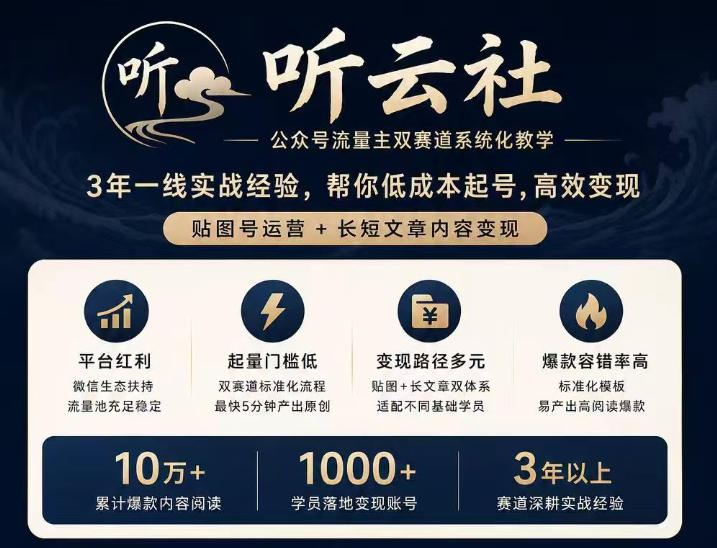
Tingyunshe official-account traffic-master dual-track systematic teaching: 3 years of frontline practice, low-cost account start and efficient monetization



TikTok Southeast Asia cross-border store practice course: market research, onboarding, product selection, listing, shipping and payment collection

Personal IP + private-domain monetization club: a personal-IP practice course to build the commercial loop of your own IP

Taobao Wanxiangtai Wujie systematic practice course: backend feature breakdown, delivery logic analysis, lowering cost and raising ROI

Tao operations 21-day crash camp: zero-basis easy Taobao operations, no empty gestures, fast replicable landing (updated Aug 2026)

Taobao Flash-Purchase, 20 yuan per order: no strong account base, no complex operation skills - beginners can enter directly


Latest August technique: register 5 Douyin accounts with one phone number - a must for matrix operation, test it if you need it