-
Solo Business Courses
-
 Others
-
Overseas Tutorials
-
Photography & Editing
-
Community & Private Domain
-
Self-Media Writing & Copywriting
-
Side Income Projects
-
E-commerce
-
Short Video & Live Streaming
-
Artificial Intelligence (AI)
-
Software & Tools
-
Operating Systems
-
Plugins & Scripts
-
MacOS Software
-
Android Software
-
Windows Software

October AI Virtual Product Training Camp PRO Edition, Xiaohongshu + WeChat Official Account + community + Moments joint playbook, hand-in-hand taking you to earn money into next year! (Updated 1029)
-
Game Gold-Farming Money-Making Plan: Earn 1k+ Daily, a Stable 3-Year Project Anyone Can Do in Spare Time [Revealed]
Study material — included with membership Get Membership -
Hot-game fully-automated earning: 500+ a day, no experience, simple operation - the steadiest long-term game-earning side hustle (revealed)
Study material — included with membership Get Membership -
FlyingMouse earns merit this time! Don't panic at Windows format problems — the open-source FlyingMouse format conversion tool helps, a popular GitHub gem
Study material — included with membership Get Membership -
Douyin Product-Selling Coaching Bootcamp: No On-Camera Appearance Needed, Newbies Can Produce Selling Short Videos by Following the Steps
Study material — included with membership Get Membership -
First-release game gold-farming money plan: 1K+ a day, ordinary people in spare time
Study material — included with membership Get Membership




-
FlyingMouse earns merit this time! Don't panic at Windows format problems — the open-source FlyingMouse format conversion tool helps, a popular GitHub gem
Study material — included with membership Get Membership -
LuDaShi v6.1024.4105.1121 Slim Single File
Study material — included with membership Get Membership -
2D Cartoon Animation Software Moho Pro v14.3
Study material — included with membership Get Membership -
Video Editor Aiseesoft Filmai v1.0.18
Study material — included with membership Get Membership -
To-Do Microsoft To Do v2.147 Free
Study material — included with membership Get Membership -
PR/AE/DaVinci/FCPX video Plugin Nobe OmniScope Win1.11.15 / Mac1.10.138
Study material — included with membership Get Membership


From October to the end of the year is when many virtual products peak, for example: certificate and civil service exams, CET-4/6, job interviews, travel and outings, midterms/monthly exams/parent-teacher meetings, year-end reports... This training camp covers projects from October to January next year; we will cover them all this time, plus many plus (upgraded) projects. Virtual products have very strong timing, so we have made these adjustments, hoping everyone can seize the opportunity and earn a quarter's worth of money!
Besides the projects, what other updates do we have this time?
Friends who make Xiaohongshu virtual products know the pain: qualifications have been a long struggle. Last month Luke and I already got personal selling up and running. One more thing here: many people don't know the benefits of personal selling: note traffic explodes (because the notes go through the regular note traffic pool), search weight is high, personal selling requires no deposit, and your delivery doesn't count against quota (making traffic diversion easier). Delivery can directly send a link and can also auto-deliver. Personal selling is so good that it would be a shame not to do it.
But the key to getting orders with personal selling is not the product, it's the note. So this time we will spend a full session thoroughly explaining the order-getting techniques for personal selling:
Also, when doing virtual products, you must not focus only on Xiaohongshu. The joint playbook of WeChat Official Account + community + Moments is a very good supplement. After all, it's underground, so you can do whatever you want, and WeChat Official Accounts are currently promoting image-text and text messages, which have a lower threshold but work very well for getting orders. Think about it: you've already made the product, so why not sell it again on your WeChat Official Account?
Many people know that my main base is the WeChat Official Account. So how do you start an account, which virtual products are suitable for selling on WeChat Official Accounts, how to find the right benchmarks, and how content, community and Moments can link up... Building a brand-new WeChat Official Account for virtual products will all be covered this time!
From the demand primer course (how to select products & identify real market demand) to breaking through in the red ocean era, the essential levers for a one-person company in the AI era, shaping selling points for virtual products, and getting started with personal selling, the system is complete
Course outline
1. Demand primer course: how to select products & identify real market demand?
1. In the red ocean era, how do you make virtual products?
2. How do you discover real demand?
3. How to become a one-person company in the AI era, and the 3 essential levers for a one-person company.
4. Methodology for shaping selling points of virtual products.
5. Getting started with personal selling: opening and product listing process, applicable products and basic preparation.
6. Personal selling order conversion techniques: selling points, previews, price expression, FAQ and consultation conversion.
7. How to build a Xiaohongshu virtual product matrix.
8. Virtual product opportunities from October to December: how to choose projects by combining audience needs, timing and personal resources?
9. How workplace professionals can build virtual products from 0 to 1: find product directions from job experience, work templates and personal experience.
II. Obsidian x AI: Build your business context system
1. Obsidian + Claude code personal knowledge base methodology.
2. Four-layer knowledge base content model: Source -> Insight -> Asset -> Context.
3. How Obsidian collects high-quality materials from WeChat official accounts, Xiaohongshu, YouTube... and turns them into your second brain.
4. How to remotely control your knowledge base.
5. Let Agents enter the "scene of the crime", such as WeChat, Feishu, Knowledge Planet, and extract opportunities into Obsidian.
6. How to painlessly accumulate personal corpus: build a workflow from inspiration to output.
7. How to build a knowledge base without wasting tokens? Establish a layered reading mechanism for AI.
8. Turn tacit experience into explicit assets: from experience -> rules -> SOP -> Skill.
9. Build your business radar system: let AI not only help you write content, but also discover opportunities.
III. AI fundamentals and AI virtual products
1. Prompt and context engineering.
2. Agent introduction: Skill, CLI, MCP and Agent setup.
3. How to install, invoke, modify and create original Skills.
4. How to build your own dedicated virtual product - a content workbench.
5. How to use AI to create original vertical-domain guides?
6. AI courseware and PPT production: themed class meetings, parent meeting PPT, knowledge point illustrations.
7. AI template and printable material production: worksheets, study plans, study tour manuals, environmental decoration and handwritten newspapers.
8. AI vertical knowledge base production: job knowledge base, English knowledge base, exam knowledge base and classic reading knowledge base.
9. AI interactive web pages and mini programs: quiz mini programs, oral practice, teacher tools.
10. How to connect scattered AI operations into a workflow?
IV. AI original virtual products (October-December project opportunities)
1. Academic affairs track: midterm exams, monthly exams, parent meetings, themed class meetings; how to use the courseware workbench and knowledge point illustrations to create differentiated products.
2. Teacher tools and environmental decoration: teacher AI toolbox, environmental decoration 2.0, product design and production of three-dimensional handwritten newspapers.
3. Workplace track: portfolios, vertical job knowledge bases, job guides, foreign company interview question banks, structured interviews and year-end reports.
4. Job search services: how to productize and deliver mock interviews, resume revision and job search diagnosis.
5. Certifications and English: CET-4 and CET-6, teacher qualification certificate, civil service exam, postgraduate entrance exam materials, targeted practice and visual knowledge products.
6. Travel track: product selection and production of study tour manuals, city travel guides and self-driving roadbooks.
7. Knowledge base track: English, workplace job and classic reading knowledge bases, how to choose topics, create original content, organize content and update.
8. Classic reading knowledge base cases: indexes, guides and knowledge organization for themes such as Selected Works of Mao, Diamond Sutra, Huangdi Neijing, Tao Te Ching, etc.
V. WeChat official account virtual products and image-text accounts
1. What profitable virtual product approaches exist for WeChat official accounts now?
2. How to find a WeChat official account virtual product track worth doing?
3. How to find benchmark accounts and break down topic selection, image structure, copywriting and product presentation methods?
4. How to split courseware, templates, resource packs, knowledge bases, and guides into WeChat official account content?
5. What kind of graphics easily generate traffic? A thorough breakdown of the viral structure of WeChat official account graphics.
6. How can WeChat official account content support conversions, upsells, and repeat purchases?
7. How can WeChat official accounts, communities, and Moments work together?
VI. Xiaohongshu virtual product note content
1. Search traffic layout: 5 effective SEO prompts.
2. Product notes VS organic traffic notes: layout and proportion.
3. How to use Skill to write notes that generate orders?
4. Account launch pack Skill and trending topic Skill: account introduction, first batch of topics, and note structure.
5. Product display, scenario, tutorial, and feedback notes: how to help users understand product uses.
6. Virtual product diagnosis Skill: how to analyze and adjust for no traffic, reads but no inquiries, and inquiries but no sales.
VII. How to start with virtual products and build your own one-person company
1. Why are virtual products the smallest business unit for ordinary people to build a one-person company?
2. How to avoid virtual products always staying at 0 to 1?
3. How to compliantly drive traffic to private domains on Xiaohongshu? How to continuously operate communities and Moments?
4. How to go from one product to a business: how to grow content, user, product, and service matrices.
5. Three paths from virtual products to a one-person company.
6. The four stages of a one-person company: validation, standardization, scaling, and assetization.
7. Product line architecture for a one-person company: TOB and TOC, traffic products, profit products, and high-ticket services.
8. Four income sources and business models for a one-person company: how to build the income structure of a one-person company?
9. How a one-person company allocates time: arrangements for products, content, customer acquisition, and delivery.
10. AI workbench for a one-person company: how to use AI, knowledge bases, and Skills to build your daily workflow.
New free Skill available
-Account launch pack Skill
-Virtual product diagnosis Skill
-IP account viral post Skill
-Courseware workbench Skill
-Knowledge base Skill
-Knowledge point diagram Skill
-Trending topic Skill
Course Content
2026-10-17 Al Xiaohongshu virtual product opening day
2026-10-18 Demand mining and one-person company
20261017195459-Al Xiaohongshu virtual product opening day-transcript text-1.docx
20261018194947-transcription_demand mining and one-person company-transcript text-1.docx
Build-in-Public-product notes Skill-sharing version.zip
guide-plus.zip
Social media assistant-v3.6.1.zip
Demand introductory course-September-luke.pdf
[Last session of 2026] Xiaohongshu virtual e-commerce 14-day training camp opening ceremony.pdf
[Knowledge point summary] Demand mining and one-person company (demand introductory course).pdf
AI Xiaohongshu virtual product training camp · opening day knowledge notes.pdf
qihao-pack-skill.zip
Feishu document
2026-10-20 AI Virtual Product Training Camp - AI Personal Information System & Self-Media Workflow.pdf
2026-10-20 [Knowledge Notes] AI Personal Information System and Self-Media Workflow.pdf
2026-10-20 AI Personal Information System and Self-Media Workflow
2026-10-22 Exam Past-Paper Vocabulary Product Skill - Share Version.zip
2026-10-22 Notes skill-xhs-guide-writer.zip
2026-10-22 Notes skill-xhs-guide-writer(1).zip
2026-10-22 AI Fundamentals and AI Original Virtual Works - Verbatim Transcript - 1.docx
2026-10-22 AI Fundamentals and AI Original Virtual Works
2026-10-26 AI Fundamentals and Original Virtual Products
2026-10-22 AI Fundamentals and AI Original Virtual Works
Supporting Study Materials
This course comes with a materials pack. Members receive the access link by email after requesting the course.
Related Courses

Family Comedy Short-Drama Creation Course: Benchmark Hot Accounts, AI-Assisted, Fast Start for Total Beginners, Grow Followers and Drive Product Sales

Amazon AI Automation Practical Course: AI Operating Mindset, Setting Up the Codex Environment, Risk-Control Checks and Automated Listing Copy

AI E-Commerce Data Tool Development Course: Learn Codex+BI From Zero, Build a Multi-Store Integrated Visualization Dashboard

Advanced AI Prompt Application: 15 Lessons | Universal Instruction Thinking + Multiple Output Modes + Full Industry Commercial Cases
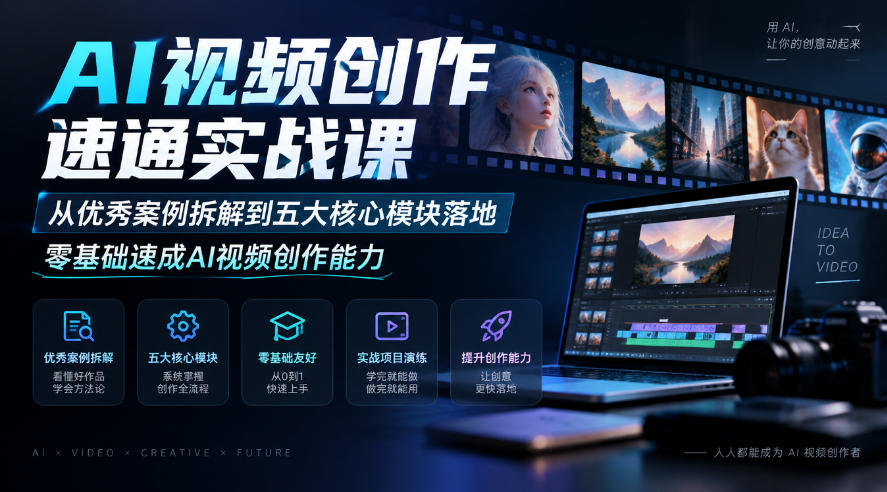
AI Video Creation Crash Course: From Great-Case Breakdown to Five Core Modules, Fast-Track AI Video Skills for Total Beginners

AI Commercial Practice System Course: In-Depth SD Mastery + Advanced Flux Hands-On + Comfyui Workflow Building, Full Commercial Design Project Training

[National-Day Pick] AI Automation Game, 1k+ RMB a Day, Simple to Operate, Stable for Three Years! [Revealed]