Categories
See All >
-
Solo Business Courses
-
 Others
-
Overseas Tutorials
-
Photography & Editing
-
Community & Private Domain
-
Self-Media Writing & Copywriting
-
Side Income Projects
-
E-commerce
-
Short Video & Live Streaming
-
Artificial Intelligence (AI)
-
Software & Tools
-
Operating Systems
-
Plugins & Scripts
-
MacOS Software
-
Android Software
-
Windows Software
Free AnyViewer v5.4.0 Free
📚Video Course
🕒Last updated: 12/23/2025
👥Entrepreneurs / Self-media creators / Cross-border e-commerce sellers / Side-hustlers
Study material — included with membership
Unlock Course with Membership
🔓
Get this course for reference study with membership
📦
Join membership — study all 16742 courses & software tools as reference
🔄
Courses keep updating — members study new material as it arrives
Share:
Top Selling Courses
-
Game Gold-Farming Money-Making Plan: Earn 1k+ Daily, a Stable 3-Year Project Anyone Can Do in Spare Time [Revealed]
Study material — included with membership Get Membership -
Hot-game fully-automated earning: 500+ a day, no experience, simple operation - the steadiest long-term game-earning side hustle (revealed)
Study material — included with membership Get Membership -
FlyingMouse earns merit this time! Don't panic at Windows format problems — the open-source FlyingMouse format conversion tool helps, a popular GitHub gem
Study material — included with membership Get Membership -
Douyin Product-Selling Coaching Bootcamp: No On-Camera Appearance Needed, Newbies Can Produce Selling Short Videos by Following the Steps
Study material — included with membership Get Membership -
First-release game gold-farming money plan: 1K+ a day, ordinary people in spare time
Study material — included with membership Get Membership






Top Selling Software Tools
-
FlyingMouse earns merit this time! Don't panic at Windows format problems — the open-source FlyingMouse format conversion tool helps, a popular GitHub gem
Study material — included with membership Get Membership -
LuDaShi v6.1024.4105.1121 Slim Single File
Study material — included with membership Get Membership -
2D Cartoon Animation Software Moho Pro v14.3
Study material — included with membership Get Membership -
Video Editor Aiseesoft Filmai v1.0.18
Study material — included with membership Get Membership -
To-Do Microsoft To Do v2.147 Free
Study material — included with membership Get Membership -
PR/AE/DaVinci/FCPX video Plugin Nobe OmniScope Win1.11.15 / Mac1.10.138
Study material — included with membership Get Membership



AnyViewer is a completely free/safe/fast remote-desktop tool; remotely access home/office PCs for full operation. It helps with remote work/gaming/cloud desktops/remote tech support etc.
\
Full system compatibility
\Supported OS:
\- \
- MS Windows 7 (all, 32/64) \
- MS Windows 8.1 (all, 32/64) \
- MS Windows 10 (all, 32/64) \
- MS Windows 11 (all, 32/64) \
- MS Windows Server 2012 R2 (all, 32/64) \
- MS Windows Server 2016 (all, 32/64) \
- MS Windows Server 2019 (all, 32/64) \
Convenient network settings
\AnyViewer easily establishes remote connections, usually no firewall config needed. In most networks, as long as the PC can access the internet, AnyViewer runs stably. Typically, when AnyViewer connects, the firewall doesn't block its traffic.
\But in some special network environments — e.g., corporate networks with strict security policies — firewalls may block all unauthorized external connections. In that case, manually configure firewall rules to allow AnyViewer through to the external network.
\Required network-port info
\AnyViewer required ports:
\- \
- UDP port: 30196 \
- TCP ports: 30192, 30193 \
Usage Notes
\- \
- During remote session, don't close AnyViewer. \
- No file transfer between controller/client yet; coming later. \
- Remote desktop doesn't support Ctrl+Alt+Del yet, coming later. \
- One controlled device only accepts one controller's remote control. When a new controller connects to the controlled device, the existing remote connection auto-disconnects. Future versions plan one controller managing multiple controlled devices simultaneously. \
- When Windows reboots, remote connection drops; re-enter security code to reconnect. \
- Sleep/hibernate breaks connection; disable auto-sleep, but monitor off OK. \
Related Courses
Study material — included with membership
Get Membership
Super local toolbox! Built-in screen recording, audio/video cutting & merging, video compression & extraction, forever free - Kedou Video Converter

Study material — included with membership
Get Membership
100% perfect free tool! One-stop multi-function PDF software: PDF convert, compress, edit etc., minimal, no ads, so nice - JOPDF
Study material — included with membership
Get Membership
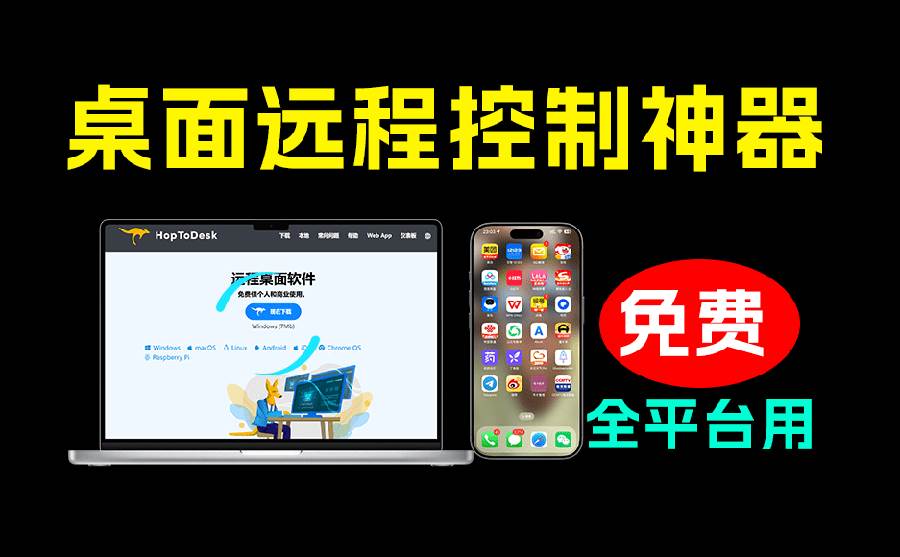
Open-Source Desktop Remote Tool, Beats Paid Versions! Free for Personal and Commercial Use Unlimited, Cross-Platform, HopToDesk Remote Control

Study material — included with membership
Get Membership
Latest K-12 Textbook Downloader: Whole-Grade Resource Download, Courseware, Video, Audio in One Click

Study material — included with membership
Get Membership
HuyanBao: free blue-light eye-care app with pet break reminders
Study material — included with membership
Get Membership
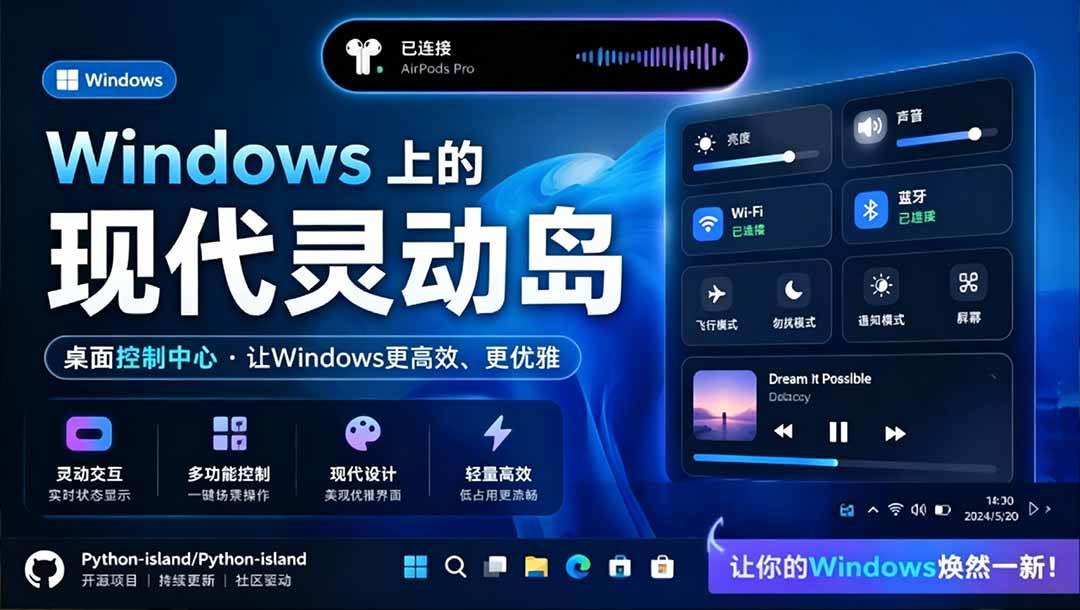
Windows Can Have a Desktop Dynamic Island Too! A Modern System Control Center — Give Your PC a Black Notch, PyIsland

Study material — included with membership
Get Membership
3D Simulated Comic Drama Production: Seedance2.0 Full-Process Practical Course - From Zero to One High-Quality Comic Drama Creation

Study material — included with membership
Get Membership
Win/Mac Dual Support! Latest Permanent Lifetime Version, Supports Old Photo Restoration, Image Sharpening and Lossless Upscaling Tool, Aiarty Image Enhancer

Study material — included with membership
Get Membership
Online Video Course: Github Open-Source Bilibili Video Download Tool! Supports 8K and Dolby Vision Bilibili Video Batch Download Tool, Easy to Use Bilidown


China Projects — one person, one company. No team, no middlemen. Every model here is already proven in China. Join the membership, study it as reference, and launch it locally in your country.