-
Solo Business Courses
-
 Others
-
Overseas Tutorials
-
Photography & Editing
-
Community & Private Domain
-
Self-Media Writing & Copywriting
-
Side Income Projects
-
E-commerce
-
Short Video & Live Streaming
-
Artificial Intelligence (AI)
-
Software & Tools
-
Operating Systems
-
Plugins & Scripts
-
MacOS Software
-
Android Software
-
Windows Software
7 Days to Unlock Community-Operations Core Skills: Positioning, Traffic, Setup—Full Coverage!
-
Game Gold-Farming Money-Making Plan: Earn 1k+ Daily, a Stable 3-Year Project Anyone Can Do in Spare Time [Revealed]
Study material — included with membership Get Membership -
Hot-game fully-automated earning: 500+ a day, no experience, simple operation - the steadiest long-term game-earning side hustle (revealed)
Study material — included with membership Get Membership -
FlyingMouse earns merit this time! Don't panic at Windows format problems — the open-source FlyingMouse format conversion tool helps, a popular GitHub gem
Study material — included with membership Get Membership -
Douyin Product-Selling Coaching Bootcamp: No On-Camera Appearance Needed, Newbies Can Produce Selling Short Videos by Following the Steps
Study material — included with membership Get Membership -
First-release game gold-farming money plan: 1K+ a day, ordinary people in spare time
Study material — included with membership Get Membership






-
FlyingMouse earns merit this time! Don't panic at Windows format problems — the open-source FlyingMouse format conversion tool helps, a popular GitHub gem
Study material — included with membership Get Membership -
LuDaShi v6.1024.4105.1121 Slim Single File
Study material — included with membership Get Membership -
2D Cartoon Animation Software Moho Pro v14.3
Study material — included with membership Get Membership -
Video Editor Aiseesoft Filmai v1.0.18
Study material — included with membership Get Membership -
To-Do Microsoft To Do v2.147 Free
Study material — included with membership Get Membership -
PR/AE/DaVinci/FCPX video Plugin Nobe OmniScope Win1.11.15 / Mac1.10.138
Study material — included with membership Get Membership


In today's social-driven internet era, whether for enterprises or individuals, community operations have already become an important tool for connecting users and strengthening brands. Through scientific community operations, you not only precisely position user needs but also efficiently channel traffic and achieve sustained growth. This 21-day community-operations check-in plan is a learning-and-practice-combined advanced course tailored for you!
\Course Features and Goals
\This check-in activity adopts lightweight learning design—21 days, breaking down community operations' core flow. One task a day, learning while using, step by step letting you master community setup, traffic, fission, and other skills—from newbie to independently planning operations plans.
\Detailed Course Outline
\Stage 1: Community Basics Intro
\- \
- Day 1: Intro Class – understand the course framework, recognize community operations' overall thinking, laying a foundation for follow-up learning. \
- Day 2: The Birth of Communities – explore communities' development background and meaning, understanding their role in today's internet. \
- Day 3: Community Value – analyze communities' far-reaching impact on brands, users, and enterprises. \
Stage 2: Community Setup and Traffic
\- \
- Day 4: Common Community Types – understand different community types' operations focus. \
- Day 5: Community Positioning – clarify user personas and the community's core value. \
- Day 6: Offline Traffic – learn how to combine activities to convert target users into the community. \
- Day 7: Online Traffic – master mainstream-platform traffic tricks and tools. \
- Day 8: Learning Review – organize a week's learning outcomes, consolidating what's been learned. \
Stage 3: Content Output and Operations Architecture
\- \
- Day 9: Community Composition Framework – master the core structure of setting up an efficient community. \
- Day 10-11: Operations Setup (Parts 1-2) – from staffing to task division, a detailed breakdown of how to implement community operations. \
- Day 12: Content-Output Planning – formulate high-stickiness community content strategy, continuously drawing users. \
- Day 13: How to Write Community Copy – while conveying effective information, raise interaction rate. \
Stage 4: Fission and Problem Handling
\- \
- Day 14: Operations SOP Document Reference – provide standardized process-design templates, reducing operation blind spots. \
- Day 15-16: Community Fission and Supplements – explore efficient fission plans, expanding community scale. \
- Day 17: Community Activation – keep the community active, avoiding "dead groups." \
- Day 18: Common Problems and Solutions – analyze common pitfalls in daily operations and how to respond. \
Stage 5: Practice Tools and Summary
\- \
- Day 19: Common Operations Tools – recommend practical tools, raising work efficiency. \
- Day 20: Private-Domain Operations Practice Case Reference – through real-case analysis, help deepen understanding. \
- Day 21: Check-In Summary – review 21 days' learning gains, setting direction for follow-up operations. \
Suited Audience
\Whether you're an operations newbie or a working professional looking to improve your skills, this course provides a systematic learning path for you. Improve through practice, and ultimately master the ability to independently operate communities.
Related Courses
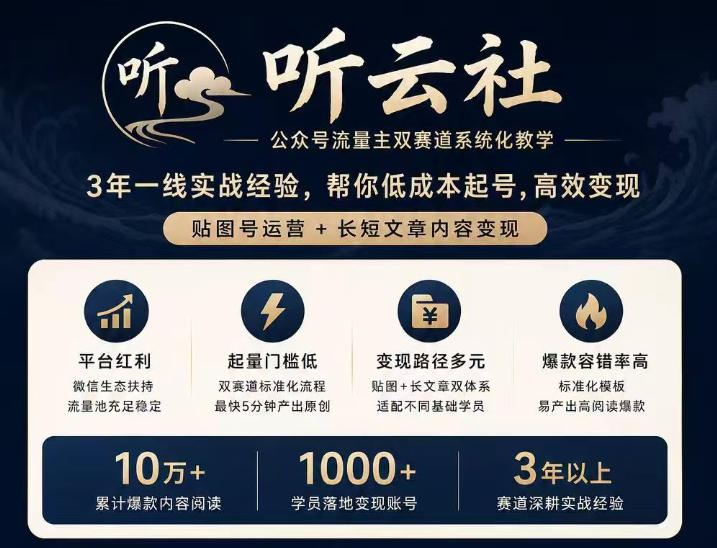
Tingyunshe official-account traffic-master dual-track systematic teaching: 3 years of frontline practice, low-cost account start and efficient monetization



TikTok Southeast Asia cross-border store practice course: market research, onboarding, product selection, listing, shipping and payment collection

Personal IP + private-domain monetization club: a personal-IP practice course to build the commercial loop of your own IP

Taobao Wanxiangtai Wujie systematic practice course: backend feature breakdown, delivery logic analysis, lowering cost and raising ROI
Tao operations 21-day crash camp: zero-basis easy Taobao operations, no empty gestures, fast replicable landing (updated Aug 2026)

Taobao Flash-Purchase, 20 yuan per order: no strong account base, no complex operation skills - beginners can enter directly


Latest August technique: register 5 Douyin accounts with one phone number - a must for matrix operation, test it if you need it