-
Solo Business Courses
-
 Others
-
Overseas Tutorials
-
Photography & Editing
-
Community & Private Domain
-
Self-Media Writing & Copywriting
-
Side Income Projects
-
E-commerce
-
Short Video & Live Streaming
-
Artificial Intelligence (AI)
-
Software & Tools
-
Operating Systems
-
Plugins & Scripts
-
MacOS Software
-
Android Software
-
Windows Software
AIGC Cinematic Creation Advanced: Tech-Empowered, New Visual Revolution
-
Game Gold-Farming Money-Making Plan: Earn 1k+ Daily, a Stable 3-Year Project Anyone Can Do in Spare Time [Revealed]
Study material — included with membership Get Membership -
Hot-game fully-automated earning: 500+ a day, no experience, simple operation - the steadiest long-term game-earning side hustle (revealed)
Study material — included with membership Get Membership -
FlyingMouse earns merit this time! Don't panic at Windows format problems — the open-source FlyingMouse format conversion tool helps, a popular GitHub gem
Study material — included with membership Get Membership -
Douyin Product-Selling Coaching Bootcamp: No On-Camera Appearance Needed, Newbies Can Produce Selling Short Videos by Following the Steps
Study material — included with membership Get Membership -
First-release game gold-farming money plan: 1K+ a day, ordinary people in spare time
Study material — included with membership Get Membership





-
FlyingMouse earns merit this time! Don't panic at Windows format problems — the open-source FlyingMouse format conversion tool helps, a popular GitHub gem
Study material — included with membership Get Membership -
LuDaShi v6.1024.4105.1121 Slim Single File
Study material — included with membership Get Membership -
2D Cartoon Animation Software Moho Pro v14.3
Study material — included with membership Get Membership -
Video Editor Aiseesoft Filmai v1.0.18
Study material — included with membership Get Membership -
To-Do Microsoft To Do v2.147 Free
Study material — included with membership Get Membership -
PR/AE/DaVinci/FCPX video Plugin Nobe OmniScope Win1.11.15 / Mac1.10.138
Study material — included with membership Get Membership

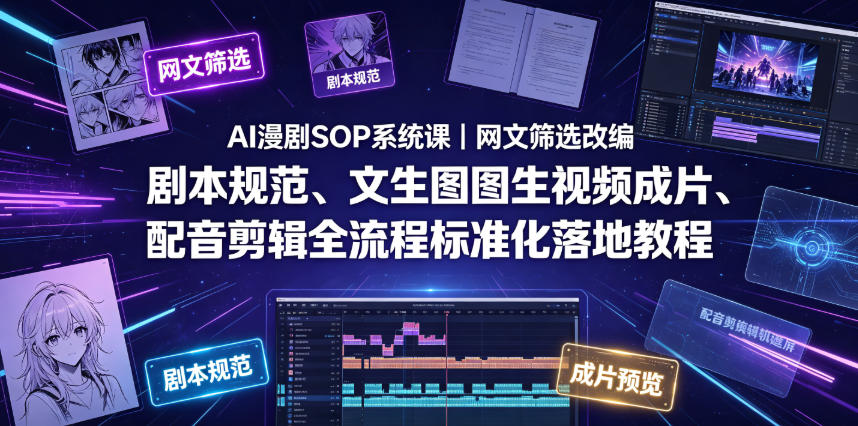
AIGC is changing filmmaking. It's no longer just a gimmick—it's entered the full flow from script to post. But pressing a few generate buttons isn't enough; the key is using these tools well to serve your creativity, not the reverse.
\This course solves that. It skips vague theory and gives a concrete method from tool use to aesthetic expression, helping you find your creative rhythm and edge amid rapid change.
\I. What can AIGC actually do in filmmaking?
\We first survey where AI helps in filmmaking.
\1. Scriptwriting
\Natural-language models like GPT generate synopses and enrich dialogue. Start from a simple 'tragic love story' idea and, through specific prompts ('prompt engineering'), have AI build a full script framework with key conflicts and turns—cutting early conception cost and time.
\2. Visual generation
\In art design, tools like Stable Diffusion quickly generate concept art and storyboard sketches. Input 'cyberpunk rainy-night street' and AI offers several style options, letting the art team explore and iterate fast.
\3. VFX and post
\Complex VFX once costly in traditional CGI (e.g., special fluids, smoke) can now be built with GANs. The course shows a fluid effect that once took two weeks by hand—AI may deliver a first version in 48 hours with real-time adjustment.
\4. Virtual actors
\Digital humans generate virtual performances—useful when actors are unavailable, budgets are tight, or special looks are needed. The course details using multimodal models to sync lip-sync, micro-expressions, and lines more naturally and realistically.
\II. What makes this course different?
\Many courses teach AI tools, but the core here isbalancing technical use and artistic expression。
\Not just operation—also principles
\We won't make you a 'button operator.' The course goes deeper into diffusion models and Transformer architecture, helping you understand how AI 'thinks.' Understand principles to control output, not gamble.
\Driven by real cases
\Through real projects like Virtual Idol Live and Sci-Fi Short VFX, we demo the full flow from prompts to final product. We also analyze 'failure cases'—e.g., distorted hands and weird limbs in AI-generated people—and give practical fixes.
\Ethics and copyright
\AIGC has many disputes—training-data copyright, deepfake detection. A dedicated module discusses these and gives industry-compliant practice for peace of mind.
\Dynamic learning assessment
\How do we assess learning? Across aesthetic consistency, technical completion, and innovation. For example, a challenge like 'generate a 5-second cinematic shot with AI' gets feedback on lighting harmony and motion smoothness.
\III. Future trends and your place
\The course ends by exploring how AIGC may change the industry and how you can position yourself as a creator.
\- \
- Efficiency will be restructured: Over the next years, pre-production cycles may shrink sharply, and standard background rendering may fully automate. \
- New roles will emerge: Roles like 'AI director' and 'prompt designer'—needing both aesthetics and tech—will see growing demand. \
- The creative threshold is changing: Small teams and even solo creators can now achieve VFX scale once only big companies could afford. A student generated a grand space-fleet battle at very low cost. \
IV. What will you learn? Course list
\Below are the concrete hands-on contents, focused on local deployment and core skills, so you master key tools independently and deeply.
\- \
- 1. Script licensing – How to find and obtain compliant text material. \
- 2. Heavy recommendations for multi-function local tools – A survey of powerful software that runs on your own PC. \
- \
- 3. Qianwen-model image generation (local deployment) – Learn to deploy and use a specific model locally for image generation. \
- 4. Wanxiang-model image generation (local) – Master local generation with another style model. \
- 5. Natural-language editing model for retouching (local) – How to use natural-language prompts to precisely edit images. \
- 6. Solving 'ten-thousand faces' for unlimited actors (local) – Generate diverse, non-repeating faces to build a huge 'actor' pool. \
- 7. Custom character portraits (local) – Deep-build specific, controllable virtual character portraits. \
- 8. 'Render-level ultra-HD upscaling' pixel reconstruction (local) – The core tech to upscale low-resolution images in high quality. \
- \
- 9. Wanxiang local image-to-video (with first/last frames) – Turn static images into dynamic video clips. \
- 10. Advanced 'emotion-level' character voiceover – Generate richly emotional AI voiceover matching character settings. \
- 11. High-accuracy, high-definition character lip-sync – Match virtual-character lip-sync perfectly to any audio. \
- 12. Multimodal (character/prop) editing and fusion – Seamlessly fuse generated elements (characters, props, backgrounds) into one scene. \
In short, this course helps you not only swim in the AIGC wave but know which direction to swim. It provides tools—and, more, the thinking and aesthetic judgment to turn tech into creativity.
\Related Courses

Family Comedy Short-Drama Creation Course: Benchmark Hot Accounts, AI-Assisted, Fast Start for Total Beginners, Grow Followers and Drive Product Sales

Amazon AI Automation Practical Course: AI Operating Mindset, Setting Up the Codex Environment, Risk-Control Checks and Automated Listing Copy

AI E-Commerce Data Tool Development Course: Learn Codex+BI From Zero, Build a Multi-Store Integrated Visualization Dashboard


Advanced AI Prompt Application: 15 Lessons | Universal Instruction Thinking + Multiple Output Modes + Full Industry Commercial Cases
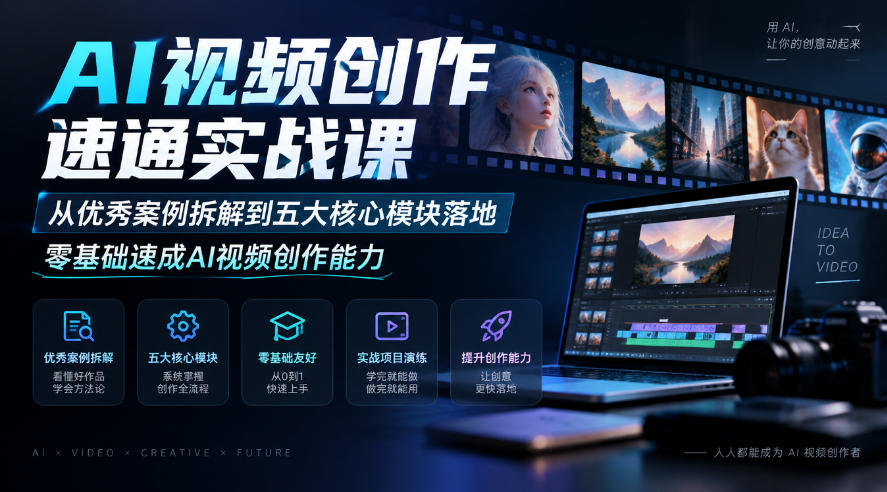
AI Video Creation Crash Course: From Great-Case Breakdown to Five Core Modules, Fast-Track AI Video Skills for Total Beginners
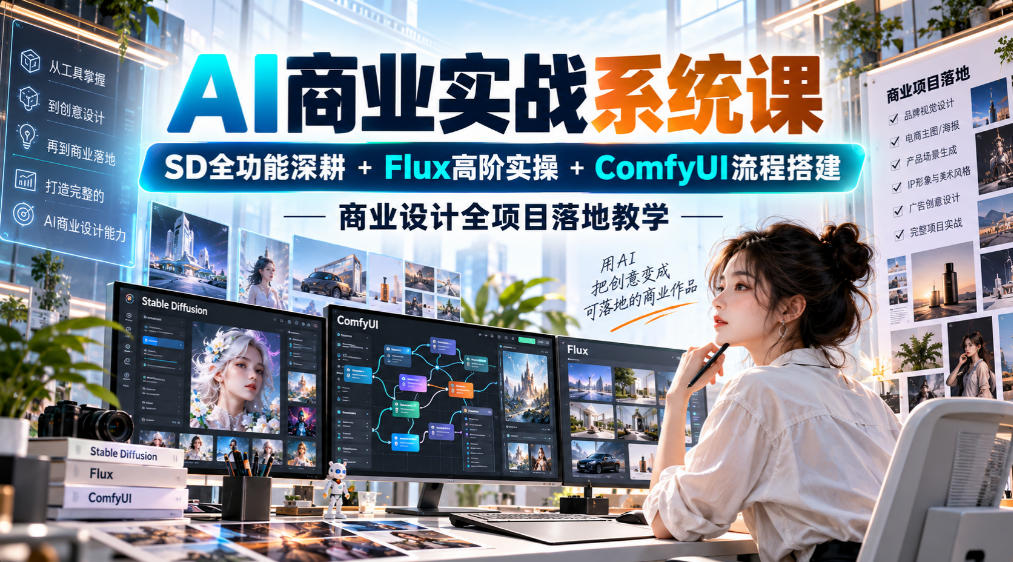
AI Commercial Practice System Course: In-Depth SD Mastery + Advanced Flux Hands-On + Comfyui Workflow Building, Full Commercial Design Project Training

[National-Day Pick] AI Automation Game, 1k+ RMB a Day, Simple to Operate, Stable for Three Years! [Revealed]