-
Solo Business Courses
-
 Others
-
Overseas Tutorials
-
Photography & Editing
-
Community & Private Domain
-
Self-Media Writing & Copywriting
-
Side Income Projects
-
E-commerce
-
Short Video & Live Streaming
-
Artificial Intelligence (AI)
-
Software & Tools
-
Operating Systems
-
Plugins & Scripts
-
MacOS Software
-
Android Software
-
Windows Software

[Updated] AI Large-Model Application Development: Environment Setup to Project Delivery
-
Game Gold-Farming Money-Making Plan: Earn 1k+ Daily, a Stable 3-Year Project Anyone Can Do in Spare Time [Revealed]
Study material — included with membership Get Membership -
Hot-game fully-automated earning: 500+ a day, no experience, simple operation - the steadiest long-term game-earning side hustle (revealed)
Study material — included with membership Get Membership -
FlyingMouse earns merit this time! Don't panic at Windows format problems — the open-source FlyingMouse format conversion tool helps, a popular GitHub gem
Study material — included with membership Get Membership -
Douyin Product-Selling Coaching Bootcamp: No On-Camera Appearance Needed, Newbies Can Produce Selling Short Videos by Following the Steps
Study material — included with membership Get Membership -
First-release game gold-farming money plan: 1K+ a day, ordinary people in spare time
Study material — included with membership Get Membership






-
FlyingMouse earns merit this time! Don't panic at Windows format problems — the open-source FlyingMouse format conversion tool helps, a popular GitHub gem
Study material — included with membership Get Membership -
LuDaShi v6.1024.4105.1121 Slim Single File
Study material — included with membership Get Membership -
2D Cartoon Animation Software Moho Pro v14.3
Study material — included with membership Get Membership -
Video Editor Aiseesoft Filmai v1.0.18
Study material — included with membership Get Membership -
To-Do Microsoft To Do v2.147 Free
Study material — included with membership Get Membership -
PR/AE/DaVinci/FCPX video Plugin Nobe OmniScope Win1.11.15 / Mac1.10.138
Study material — included with membership Get Membership


AI Large-Model Application Development Practice, Comprehensively Master AI Large-Model Development Technology
\ \Posted:March 21, 2026
\🏷️ Course Type:AI large-model development practice tutorial
\AudienceProgramming newcomers, working developers, technical leads
\⏱️ Learning Objectives:Master environment setup, prompt engineering, API calls, and the full project-development flow
\Currently, AI large-model technology is exploding, deeply penetrating multiple fields such as software development, enterprise services, and intelligent interaction, becoming the core driver of industrial upgrading. Market demand for AI large-model application-development talent keeps surging, but the industry generally faces the dilemma of wanting to enter but having no way in: most developers, though aware of AI large models' potential, get stuck at the basic step of development-environment setup, lack systematic understanding of prompt engineering, and struggle to convert large-model ability into real applications; at the same time, the lack of key skills like OpenAI API calls, tool adaptation, and project practice leaves many practitioners only at the theory level, unable to meet enterprises' demand for practice-oriented AI development talent.
\To this end, we specially invited lecturer Andy, deeply rooted in the AI technology field with rich practice experience, to bring the premium course 'AI Large-Model Application Development Practice.' Lecturer Andy is proficient in the full large-model application-development flow, familiar with various development tools and technical details; through a 'theory + practice' approach, he will take students to avoid development pitfalls and efficiently master core skills.
\This course aims to build for students a complete learning path from zero basis to practical application.Courses not only coverConda, Mamba, Jupyter Notebook, PyCharm and other development environments'one-stop setup and configuration , and more deeply explainsprompt engineering 's core principles and best practices, helping students master the skill of efficient dialogue with large models and significantly lift output quality. In the practice part, the course will systematically explainOpenAI API 's call details,Apifox and other development tools' efficient use, and finally lead students to usePython and the Streamlit frameworkto independently develop a fully functional AI chat app, achieving the key leap from theoretical cognition to project implementation.
\Through this course, students willthoroughly open up the 'last mile' of AI application development , possessing the ability to convert cutting-edge AI technology into actual products or solutions; whether for personal skill improvement, in-enterprise project development, or exploring new entrepreneurship directions, they will gain solidtechnical support and practice confidence。
\CURRICULUM
\
\
Chapter 1: AI Large-Model Development Environment Setup
\- \
- Conda environment management onboarding and installation \
- Conda common commands and Mamba use \
- Jupyter Notebook configuration and use \
- Configuring the Conda development environment in PyCharm \
Chapter 2: Prompt Engineering Best Practices
\- \
- Prompt basic concepts and engineering definition \
- Prompt Engineering core tricks and best practices \
- Advanced Prompt Engineering Techniques and Structured Output \
- Prompt Design and Optimization in Real-World Application Scenarios \
Chapter 3: AI Application Development Quick Start and Practice
\- \
- Detailed Explanation of OpenAI Large Model Parameters and API Documentation Reading \
- API Key Acquisition and Environment Variable Configuration (Command Line) \
- Apifox Tool Usage: Project Import, Environment Switching, Proxy Setup, and Troubleshooting \
- OpenAI Model Pricing Strategy and Cost Control \
- Developing an AI Chat Application Based on Python and the Streamlit Framework (Complete Project Practice) \
[March 2026] Updated Content
\🕒 Update Time: March 2026
\Add the following chapters:
\ \[Skill Fundamentals and Principles]
\- \
- Why We Need Skills \
- Skill Fundamental Concepts and Engineering Definitions \
- Skill Operating Environment and Core Principles \
- Skill Engineering Practice Guide \
- Skill Enterprise Application in Practice \
- Skill Summary & Outlook \
[Multi-Platform Skill Building Practice]
\- \
- Building Skills with Claude Code \
- Building Skills with Trae IDE \
- Building and Deploying Skills with Button Programming \
- Installing Skills from the CodeBuddy Skills Marketplace \
- Managing Projects and Users with CodeBuddy Skills \
- Building Enterprise Skills with CodeBuddy \
[Multi-Tool Integration and Advanced Topics]
\- \
- Codex Skills Overview \
- Building Codex Skills \
- Using Codex Skills \
- Building OpenClaw Skills \
- Using OpenClaw Skills \
- Using the ClawHub Skill Store \
📋 Update Highlights:
\- \
- Comprehensive Skill Concept Analysis:From basic concepts and engineering definitions to operating principles and engineering practice, systematically master the complete knowledge system of WorkBuddy Skill. \
- Enterprise-Grade Application Practice:In-depth explanation of how to apply Skills to real enterprise scenarios, and enterprise-grade Skill architecture design methods. \
- Multi-Platform Building Practice:Covering Skill building workflows for three mainstream platforms: Claude Code, Trae IDE, and Coze Coding. \
- CodeBuddy Ecosystem:Learn how to install and manage project and user Skills in the CodeBuddy skill marketplace, and build enterprise-grade Skills. \
- Multi-tool integration expansion:Mastering Codex Skills, OpenClaw Skills' building and use methods, as well as ClawHub skill store's practical operations. \
- Skill full-lifecycle management:The complete closed loop from development, deployment to use and management, laying a solid foundation for later custom WorkBuddy skills. \
💡 Learning Tips:
The tutorial content is based on industry practice at publication time; AI technology and platform APIs update quickly. When learning, combine with current latest official docs and community developments, flexibly apply learned knowledge to achieve the best learning effect.
Related Courses

Family Comedy Short-Drama Creation Course: Benchmark Hot Accounts, AI-Assisted, Fast Start for Total Beginners, Grow Followers and Drive Product Sales

Amazon AI Automation Practical Course: AI Operating Mindset, Setting Up the Codex Environment, Risk-Control Checks and Automated Listing Copy

AI E-Commerce Data Tool Development Course: Learn Codex+BI From Zero, Build a Multi-Store Integrated Visualization Dashboard

Advanced AI Prompt Application: 15 Lessons | Universal Instruction Thinking + Multiple Output Modes + Full Industry Commercial Cases
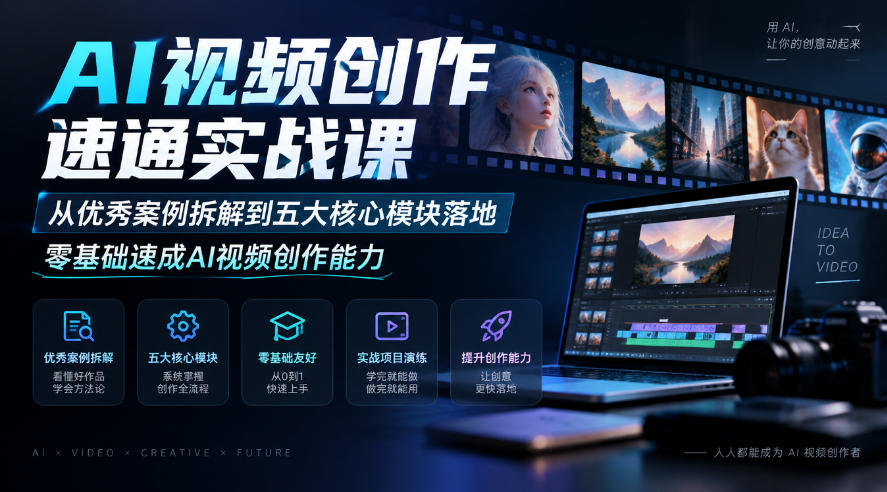
AI Video Creation Crash Course: From Great-Case Breakdown to Five Core Modules, Fast-Track AI Video Skills for Total Beginners

AI Commercial Practice System Course: In-Depth SD Mastery + Advanced Flux Hands-On + Comfyui Workflow Building, Full Commercial Design Project Training

[National-Day Pick] AI Automation Game, 1k+ RMB a Day, Simple to Operate, Stable for Three Years! [Revealed]