-
Solo Business Courses
-
 Others
-
Overseas Tutorials
-
Photography & Editing
-
Community & Private Domain
-
Self-Media Writing & Copywriting
-
Side Income Projects
-
E-commerce
-
Short Video & Live Streaming
-
Artificial Intelligence (AI)
-
Software & Tools
-
Operating Systems
-
Plugins & Scripts
-
MacOS Software
-
Android Software
-
Windows Software

Ordinary People's AI Image Generation Practicum – 2026 Latest Guide
-
Game Gold-Farming Money-Making Plan: Earn 1k+ Daily, a Stable 3-Year Project Anyone Can Do in Spare Time [Revealed]
Study material — included with membership Get Membership -
Hot-game fully-automated earning: 500+ a day, no experience, simple operation - the steadiest long-term game-earning side hustle (revealed)
Study material — included with membership Get Membership -
FlyingMouse earns merit this time! Don't panic at Windows format problems — the open-source FlyingMouse format conversion tool helps, a popular GitHub gem
Study material — included with membership Get Membership -
Douyin Product-Selling Coaching Bootcamp: No On-Camera Appearance Needed, Newbies Can Produce Selling Short Videos by Following the Steps
Study material — included with membership Get Membership -
First-release game gold-farming money plan: 1K+ a day, ordinary people in spare time
Study material — included with membership Get Membership






-
FlyingMouse earns merit this time! Don't panic at Windows format problems — the open-source FlyingMouse format conversion tool helps, a popular GitHub gem
Study material — included with membership Get Membership -
LuDaShi v6.1024.4105.1121 Slim Single File
Study material — included with membership Get Membership -
2D Cartoon Animation Software Moho Pro v14.3
Study material — included with membership Get Membership -
Video Editor Aiseesoft Filmai v1.0.18
Study material — included with membership Get Membership -
To-Do Microsoft To Do v2.147 Free
Study material — included with membership Get Membership -
PR/AE/DaVinci/FCPX video Plugin Nobe OmniScope Win1.11.15 / Mac1.10.138
Study material — included with membership Get Membership





An AI image generation method that even ordinary people can learn, breaking down the images in your mind into requirements that AI can understand and reliably execute
\\ 2026-05-09
\ AI Painting and Prompt Engineering
\ Self-media creators, knowledge bloggers, e-commerce sellers, content operations personnel
Course Introduction
\Many people's first reaction when learning AI image generation is to look for prompts. But after real hands-on practice, you'll find that prompts are only surface-level; what you truly need to train is an ability: breaking down the images in your mind into requirements that AI can understand and reliably execute. This document doesn't talk about "stacking words," but rather a methodology closer to real workflows: first define the purpose, then break down the image, then write the instructions, then check the results, then keep refining. The real problem it solves is not making you a designer or memorizing terminology, but addressing real pain points such as WeChat official account illustrations not matching content, Xiaohongshu covers looking good but being incomprehensible to users, knowledge cards having cluttered information, product posters lacking trustworthiness, and personal IP styles being inconsistent. The true value of AI image generation is not helping you generate a picture that looks good, but helping you make your content, products, and expression clearer.
\The course starts with the five core questions of the "image generation requirements sheet," helping you think clearly before you start writing. Then it deeply breaks down the 6 image switches of a picture: person/object, environment, visual temperament, lighting, camera angle, and text. Each switch comes with detailed templates and examples. After that, it teaches you the universal structure for combining switches into complete prompts, as well as core techniques in image-to-image scenarios such as changing style, background, and clothing. The course also specifically covers the methodology of image replication, teaching you to break down the structure of a good image and replace it with your own theme. Additionally, for knowledge bloggers, it provides a complete practical workflow from writing the purpose to revising the generated image, along with 8 commonly used prompt templates, common problem correction methods, and poster replication instructions. This is a complete system from thinking to hands-on practice, helping any ordinary person reliably output high-quality AI images without relying on complex terminology.
\- \
- 1.Don't rush to write prompts; first write the "image generation requirements sheet" \
- 2.A single image can be broken down into 6 "image switches" \
- \
- 3.Person/Object: Who is the main subject of the image? \
- 4.Environment: Where is the main subject? \
- 5.Visual Temperament: What does this image look like? \
- 6.Lighting: Where does the emotion of this image come from? \
- 7.Camera Angle: From what angle does the user view this image? \
- 8.Text: Should copy appear on the image? \
- \
- 9.Combining the 6 switches into a complete prompt \
- 10.The core of image-to-image: first say "what stays the same," then say "what changes" \
- \
- 11.Image Replication: Not copying, but breaking down structure \
- 12.Poster Replication: Keep the layout first, then replace the product \
- \
- 13.Common Problems and Correction Methods \
- 14.Practical Image Generation Workflow for Knowledge Bloggers \
- 15.Original Prompt Template Library (8 Templates) \
💡 Learning Tip: Tutorial content is based on industry practices at time of publication; please verify against current platform rules when learning.
\Related Courses

Family Comedy Short-Drama Creation Course: Benchmark Hot Accounts, AI-Assisted, Fast Start for Total Beginners, Grow Followers and Drive Product Sales

Amazon AI Automation Practical Course: AI Operating Mindset, Setting Up the Codex Environment, Risk-Control Checks and Automated Listing Copy

AI E-Commerce Data Tool Development Course: Learn Codex+BI From Zero, Build a Multi-Store Integrated Visualization Dashboard

Advanced AI Prompt Application: 15 Lessons | Universal Instruction Thinking + Multiple Output Modes + Full Industry Commercial Cases
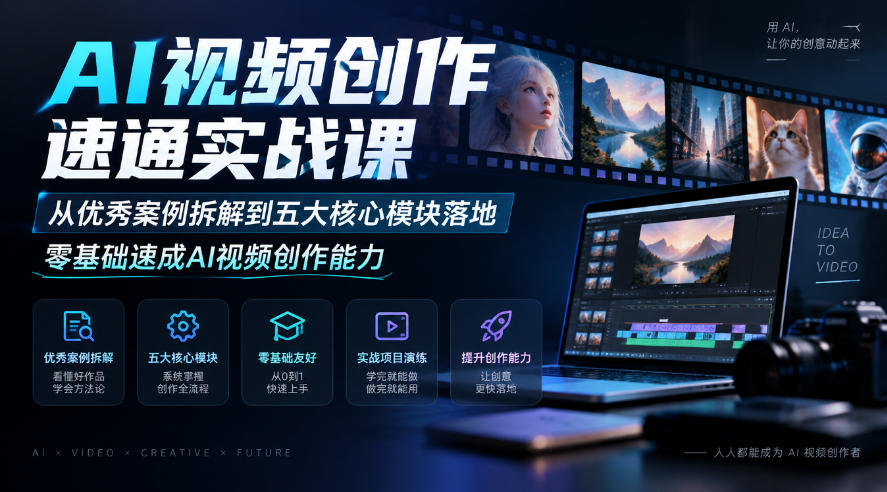
AI Video Creation Crash Course: From Great-Case Breakdown to Five Core Modules, Fast-Track AI Video Skills for Total Beginners
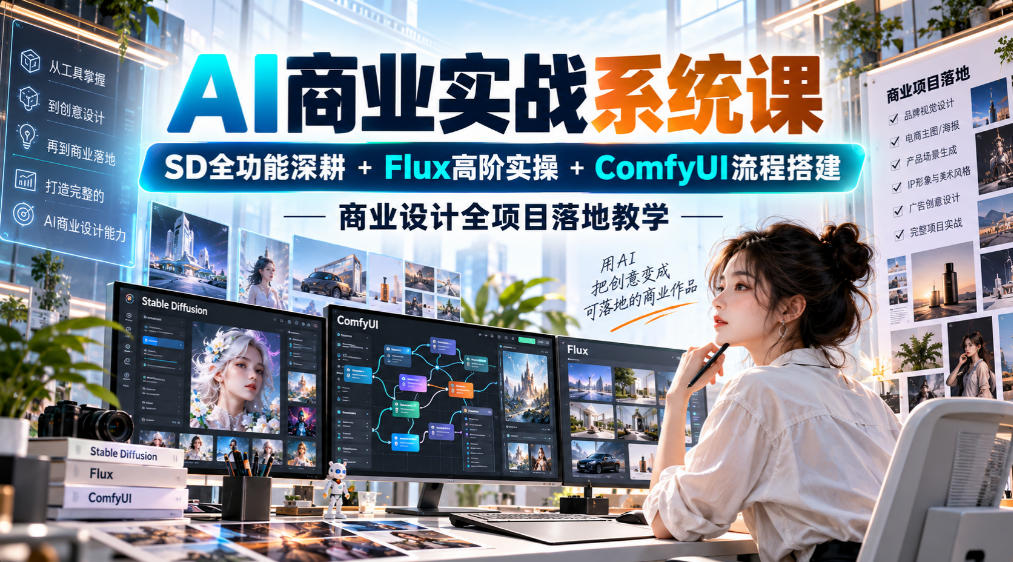
AI Commercial Practice System Course: In-Depth SD Mastery + Advanced Flux Hands-On + Comfyui Workflow Building, Full Commercial Design Project Training

[National-Day Pick] AI Automation Game, 1k+ RMB a Day, Simple to Operate, Stable for Three Years! [Revealed]