-
Solo Business Courses
-
 Others
-
Overseas Tutorials
-
Photography & Editing
-
Community & Private Domain
-
Self-Media Writing & Copywriting
-
Side Income Projects
-
E-commerce
-
Short Video & Live Streaming
-
Artificial Intelligence (AI)
-
Software & Tools
-
Operating Systems
-
Plugins & Scripts
-
MacOS Software
-
Android Software
-
Windows Software
AI Agent from Theory to Practice System Course
-
Game Gold-Farming Money-Making Plan: Earn 1k+ Daily, a Stable 3-Year Project Anyone Can Do in Spare Time [Revealed]
Study material — included with membership Get Membership -
Hot-game fully-automated earning: 500+ a day, no experience, simple operation - the steadiest long-term game-earning side hustle (revealed)
Study material — included with membership Get Membership -
FlyingMouse earns merit this time! Don't panic at Windows format problems — the open-source FlyingMouse format conversion tool helps, a popular GitHub gem
Study material — included with membership Get Membership -
Douyin Product-Selling Coaching Bootcamp: No On-Camera Appearance Needed, Newbies Can Produce Selling Short Videos by Following the Steps
Study material — included with membership Get Membership -
First-release game gold-farming money plan: 1K+ a day, ordinary people in spare time
Study material — included with membership Get Membership






-
FlyingMouse earns merit this time! Don't panic at Windows format problems — the open-source FlyingMouse format conversion tool helps, a popular GitHub gem
Study material — included with membership Get Membership -
LuDaShi v6.1024.4105.1121 Slim Single File
Study material — included with membership Get Membership -
2D Cartoon Animation Software Moho Pro v14.3
Study material — included with membership Get Membership -
Video Editor Aiseesoft Filmai v1.0.18
Study material — included with membership Get Membership -
To-Do Microsoft To Do v2.147 Free
Study material — included with membership Get Membership -
PR/AE/DaVinci/FCPX video Plugin Nobe OmniScope Win1.11.15 / Mac1.10.138
Study material — included with membership Get Membership

AI Agent from Theory to Practice System Course: Agent=LLM+Harness, from AI Underlying Architecture to Hermes Engineering Setup
\\ June 30, 2026
\ AI Agent Development Practical
\ AI developers, software engineers, technical architects, technical leads
This course is a full-stack practical tutorial covering everything from AI underlying principles to AI agent engineering implementation, using a progressive logical loop: first understand the roots (AI development history), then the skeleton (Agent architecture system), and finally the practical playbook (Vibe Coding + SDD, the new-generation engineering model). The course progresses from theory to architecture to practical trends, from far to near, from macro to frontier, helping learners build a complete AI agent cognition system. The course abandons complex mathematical derivations and uses plain language to explain AI's underlying transformation from rules to statistics to large models, allowing even zero-foundation tech enthusiasts to get started quickly.
\In the AI agent engineering architecture section, the course deeply analyzes the core formula Agent=LLM+Harness. Through detailed analysis of the Hermes architecture, it helps learners see the essence through phenomena and draw inferences. You will master two core abilities: understanding the internals and architecture of AI agents through Hermes, laying a foundation for building your own AI agent; and drawing inferences through Hermes AI Coding capabilities to understand the principles and configurations of AI agents such as Claude Code, Codex, and Xiaolongxia, laying a foundation for better using AI agents. The course also covers frontier engineering practices such as Vibe Coding and SDD (Specification-Driven Development), exposing you to the most cutting-edge AI engineering practices today.
\The latter half of the course focuses on practical implementation, including a full set of verified, directly applicable operating guidelines for Claude Code + DeepSeek, as well as a Java + Spring AI hand-written AI agent Xiaodoubao project. You will learn key skills in practice, including AI Coding architecture design, workflow decomposition, state graph engine application, and Netty asynchronous optimization. The course also specially includes in-depth content such as Spring AI Alibaba AI agent source code analysis and DeepSeek pitfall analysis, helping learners avoid common traps in actual projects. The ultimate goal is to equip learners with full-stack development capabilities to build AI agents from scratch, becoming high-level technical talents in the AI era.
\- \
- 1.AI's Past, Present, and Future \
- 2.AI's Past and Future (Part 2) \
- 3.The Past and Present of Agents \
- \
- 4.The Past and Present of Agents - Harness \
- 5.The Past and Present of AI Agents: Harness Development — Driven by Open AI Codex Internal Experiments \
- 6.The Past and Present of AI Agents: Summary and Analysis by Software Engineering Godfather Martin Fowler (Part 1) \
- 7.The Past and Present of AI Agents: Summary and Analysis by Software Engineering Godfather Martin Fowler (Part 2) \
- \
- 8.The Concept and Analysis of Vibe Coding \
- 9.From Vibe Coding to Agentic Engineering \
- 10.From Vibe Coding to Spec-Driven Development \
- 11.Spec-Driven Development (SDD) In-Depth Analysis: Opportunities, Challenges, and the Future \
- \
- 12.Hermes Agent Learning Path \
- 13.Hermes Architecture Analysis \
- 14.Hermes Agent Quick Start Guide \
- 15.Hermes Configuration System (Part 1) \
- 16.Hermes Configuration System (Part 2) \
- 17.Hermes Configuration System: DeepSeek+OpenSpec+SuperPower \
- 18.Hermes Supports VSCODE ACP Plugin \
- \
- 19.Hermes AI Coding Project - Architecture Overview \
- 20.AI Coding Hands-On Practical Implementation \
- 21.AI Coding Project Development - Architecture Pitfalls and Lessons Learned \
- 22.AI Coding Code Walkthrough Analysis \
- 23.AI Coding Project Development: Spring AI Ecosystem Tech Stack Panoramic Architecture Analysis \
- 24.Refactoring Hermes Code with Claude Code \
- 25.Claude Code+OpenSpec+SuperPower Hands-On Practical Implementation \
- 26.AI Coding Workflow — Methodology Breakdown Panoramic Architecture \
- \
- 27.AI Coding Workflow — SKILL Job Functions Detailed Analysis \
- 28.AI Coding SDD Detailed Process Analysis (Part 1) \
- 29.AI Coding SDD Detailed Process Analysis (Completed) \
- 30.Workflow Demonstration and Issues with V1.0 \
- 31.Hands-On Workflow Design from 0 to 1 (Part 1) \
- 32.Hands-On Workflow Design from 0 to 1 (Part 2) \
- 33.Hands-On Workflow Design from 0 to 1 (Part 3) \
- \
- 34.Java+Spring AI Agent Development Analysis (Part 1) \
- 35.Java+Spring AI Agent Development Analysis (Part 2) \
- 36.Spring AI Alibaba Agent Source Code Analysis \
- 37.Spring AI Alibaba DeepSeek Pitfall Analysis and Spring Version Unified Management \
- 38.The Core of an Agent Is the Graph Engine \
- \
- 39.What Is the Relationship Between State Graph and React? How to Implement It? \
- 40.Parallel Multithreaded Concurrent Edges \
- 41.State Graph Q&A (Part 1) \
- 42.State Graph Q&A (Part 2) \
- 43.Tech Stack Netty Asynchronization Overview \
- 44.Netty EventLoop Panoramic Architecture Overview \
- 45.Spring Boot and Netty bridge integration and how to customize the threading model \
- 46.Spring bridging Netty: how Spring hides technical details \
💡 Learning Tip:Content reflects industry practices at time of publication. Please refer to the latest platform rules when learning.
\Related Courses

Family Comedy Short-Drama Creation Course: Benchmark Hot Accounts, AI-Assisted, Fast Start for Total Beginners, Grow Followers and Drive Product Sales

Amazon AI Automation Practical Course: AI Operating Mindset, Setting Up the Codex Environment, Risk-Control Checks and Automated Listing Copy

AI E-Commerce Data Tool Development Course: Learn Codex+BI From Zero, Build a Multi-Store Integrated Visualization Dashboard

Advanced AI Prompt Application: 15 Lessons | Universal Instruction Thinking + Multiple Output Modes + Full Industry Commercial Cases
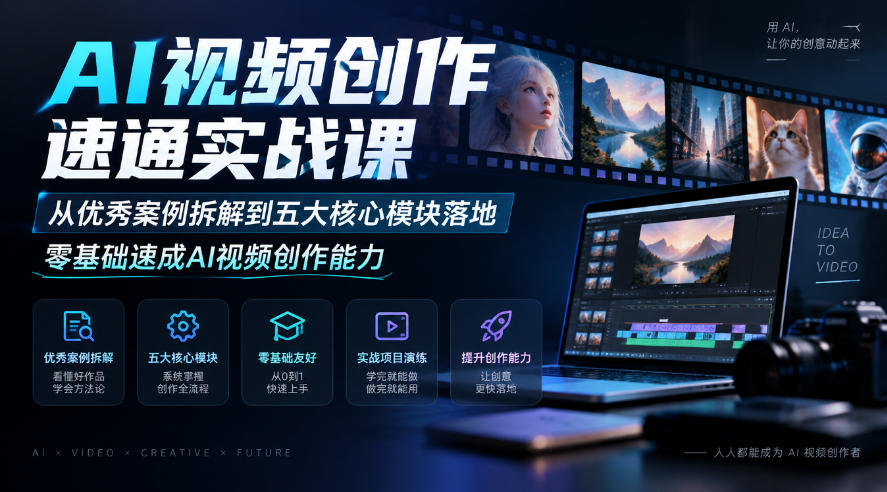
AI Video Creation Crash Course: From Great-Case Breakdown to Five Core Modules, Fast-Track AI Video Skills for Total Beginners

AI Commercial Practice System Course: In-Depth SD Mastery + Advanced Flux Hands-On + Comfyui Workflow Building, Full Commercial Design Project Training

[National-Day Pick] AI Automation Game, 1k+ RMB a Day, Simple to Operate, Stable for Three Years! [Revealed]