-
Solo Business Courses
-
 Others
-
Overseas Tutorials
-
Photography & Editing
-
Community & Private Domain
-
Self-Media Writing & Copywriting
-
Side Income Projects
-
E-commerce
-
Short Video & Live Streaming
-
Artificial Intelligence (AI)
-
Software & Tools
-
Operating Systems
-
Plugins & Scripts
-
MacOS Software
-
Android Software
-
Windows Software

AI Learning 2.0 Practical Course - Latest Guide
-
Game Gold-Farming Money-Making Plan: Earn 1k+ Daily, a Stable 3-Year Project Anyone Can Do in Spare Time [Revealed]
Study material — included with membership Get Membership -
Hot-game fully-automated earning: 500+ a day, no experience, simple operation - the steadiest long-term game-earning side hustle (revealed)
Study material — included with membership Get Membership -
FlyingMouse earns merit this time! Don't panic at Windows format problems — the open-source FlyingMouse format conversion tool helps, a popular GitHub gem
Study material — included with membership Get Membership -
Douyin Product-Selling Coaching Bootcamp: No On-Camera Appearance Needed, Newbies Can Produce Selling Short Videos by Following the Steps
Study material — included with membership Get Membership -
First-release game gold-farming money plan: 1K+ a day, ordinary people in spare time
Study material — included with membership Get Membership






-
FlyingMouse earns merit this time! Don't panic at Windows format problems — the open-source FlyingMouse format conversion tool helps, a popular GitHub gem
Study material — included with membership Get Membership -
LuDaShi v6.1024.4105.1121 Slim Single File
Study material — included with membership Get Membership -
2D Cartoon Animation Software Moho Pro v14.3
Study material — included with membership Get Membership -
Video Editor Aiseesoft Filmai v1.0.18
Study material — included with membership Get Membership -
To-Do Microsoft To Do v2.147 Free
Study material — included with membership Get Membership -
PR/AE/DaVinci/FCPX video Plugin Nobe OmniScope Win1.11.15 / Mac1.10.138
Study material — included with membership Get Membership





AI Learning 2.0 Practical Course: Let AI Truly Work for You, from Tool Usage to Agent Workflows, Building a Personal AI Productivity System
\\ July 16, 2026
\ AI Productivity System in Practice
\ Professionals, Entrepreneurs, Students, Content Creators, Managers
This course centers on the core goal of "letting AI truly work for you," systematically breaking down how ordinary people can use AI to improve work efficiency and build their own AI productivity system, from foundational AI understanding to practical application scenarios. The course first helps you establish correct AI awareness, understand the differences between large models, agents, and AI tools, and master methods for choosing different models, avoiding the dilemma of only knowing how to use tools without being able to solve problems.
\The course includes extensive hands-on practice in real scenarios, covering high-frequency office needs such as batch image processing, automatic report merging, converting customer recordings into proposals, material organization, knowledge base building, paper processing, and data analysis. In addition, it provides in-depth coverage of agents and automation, including Agent tools, the Skills system, and prompt optimization methods, helping you not only use AI but also train AI to complete fixed tasks, handing repetitive work over to AI for automatic processing.
\After completing this course, you will master a complete AI workflow method from "discovering tasks → assessing value → designing processes → invoking AI → automatic execution," upgrading AI from a chat tool to your dedicated digital employee and truly doubling your efficiency.
\Course Contents
\- \
- 1.Survival Strategies Amid the Great Transformation of the AI Era \
- 2.Selected Implementation Case Studies \
- 3.Those who are prepared will not be let down by the times \
- \
- 4.The difference between agents and ordinary chatbots \
- 5.Downloading and installing QoderWork \
- 6.Demonstration of QoderWork's basic functions \
- 7.Downloading and installing WorkBuddy \
- 8.Demonstration of WorkBuddy's basic functions \
- \
- 9.Mindset shift \
- 10.Practice: How to quickly combine multiple images into one PDF \
- 11.Practice: Merge multiple reports with one click, say goodbye to copy and paste \
- 12.Practice: Turn customer call transcripts into actionable sales follow-up plans \
- 13.When you're not satisfied with the results, what should you do first \
- 14.The 6 pitfalls beginners fall into most easily \
- 15.Chapter summary \
- \
- 16.What exactly is a large model? \
- 17.Stop only saying ChatGPT: large models actually come in several categories \
- 18.To judge how powerful a model is, what should you look at? \
- 19.Why do some models answer like experts while others seem to make things up, given the same sentence? \
- 20.Why isn't more data fed to AI always better? \
- 21.Why does AI become more likely to go off track the longer you chat? \
- 22.Why does AI spout nonsense with a straight face? \
- 23.Free, subscription, API, local models—how should you choose? \
- 24.What is an agent? How is it different from an ordinary chatbot? \
- 25.What's the difference between one AI working and a group of AIs dividing the work? \
- 26.Verify AI output first \
- \
- 27.Judge the value first, then call AI: don't spend time on low-return tasks \
- 28.Find clues in a day: the task scanning method for study, work, and life \
- 29.Find inspiration from real cases: 7 types of scenarios to open up your thinking \
- 30.Look at task attributes first: one-time, repetitive, and high-value tasks—where does the return differ \
- 31.Use 5 questions to judge priority: is this scenario worth doing now \
- 32.Order of AI tasks: which are suitable to do first, and which to avoid for now \
- 33.Complete a scenario scanning table on the spot: turn ideas into an actionable checklist \
- \
- 34.What common tools are there \
- 35.How to input large amounts of text quickly and accurately \
- 36.Fact-checking \
- 37.Turn materials into a knowledge assistant that answers questions anytime \
- 38.Unlock the IMA knowledge base \
- 39.15-day project application rescue: from vague direction to topic rationale \
- 40.How to quickly learn video and audio content and extract the most valuable information \
- 41.How to translate papers into Chinese while preserving the original formatting \
- 42.How to use AI to process data efficiently \
- 43.Your AI tool toolbox \
- 44.What are the criteria for a good or bad AI tool? \
- 45.Chapter Summary \
- \
- 46.The model is already very powerful, so why still learn prompts? \
- 47.The macro-level thinking behind prompts \
- 48.Key prompt techniques \
- 49.Prompt optimization methods \
- 50.What are Skills, and why learn Skills? \
- 51.Common agent tool recommendations \
- 52.Easily get started with installing Skills \
- 53.Easily use your first Skill \
- 54.Must-have Skills: find-skills to search a massive library of Skills \
- 55.Must-have Skills: dokobot automatically scrapes web content \
- 56.Useful Skills: quickly generate beautiful PPTs \
- 57.Useful Skills: superpowers \
- 58.Skills marketplace: a huge library of skills \
- 59.Why the public Skills marketplace isn't enough? \
- 60.Quickly identify tasks worth packaging as Skills \
- 61.Standard Skill creation workflow \
- 62.Skills best practices \
- 63.Common Skill pitfalls \
- 64.Case study: interpreting in-depth articles/papers/industry reports to uncover the most useful information \
- 65.Real case: handle multi-department reports in 10 minutes, from copy-paste to one-click merge \
💡 Learning Tip:Content reflects industry practices at time of publication. Please refer to the latest platform rules when learning.
\Related Courses

Family Comedy Short-Drama Creation Course: Benchmark Hot Accounts, AI-Assisted, Fast Start for Total Beginners, Grow Followers and Drive Product Sales

Amazon AI Automation Practical Course: AI Operating Mindset, Setting Up the Codex Environment, Risk-Control Checks and Automated Listing Copy

AI E-Commerce Data Tool Development Course: Learn Codex+BI From Zero, Build a Multi-Store Integrated Visualization Dashboard


Advanced AI Prompt Application: 15 Lessons | Universal Instruction Thinking + Multiple Output Modes + Full Industry Commercial Cases
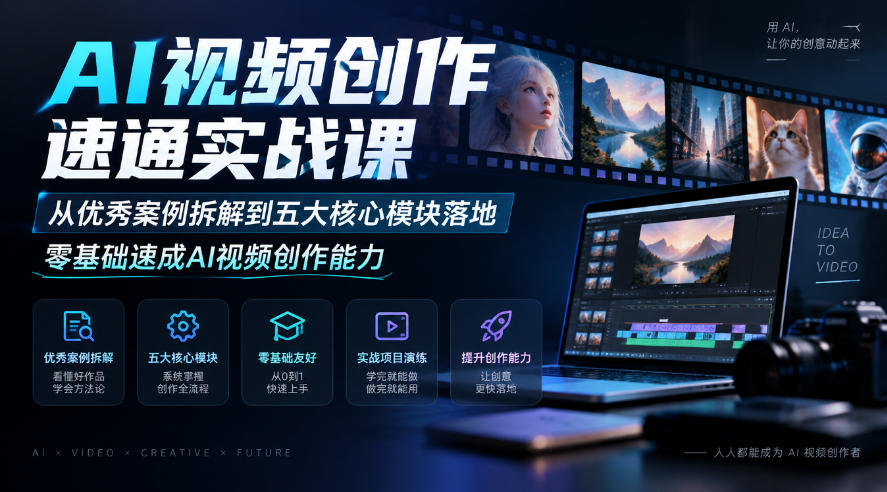
AI Video Creation Crash Course: From Great-Case Breakdown to Five Core Modules, Fast-Track AI Video Skills for Total Beginners

AI Commercial Practice System Course: In-Depth SD Mastery + Advanced Flux Hands-On + Comfyui Workflow Building, Full Commercial Design Project Training

[National-Day Pick] AI Automation Game, 1k+ RMB a Day, Simple to Operate, Stable for Three Years! [Revealed]