


-
Solo Business Courses
-
 Others
-
Overseas Tutorials
-
Photography & Editing
-
Community & Private Domain
-
Self-Media Writing & Copywriting
-
Side Income Projects
-
E-commerce
-
Short Video & Live Streaming
-
Artificial Intelligence (AI)
-
Software & Tools
-
Operating Systems
-
Plugins & Scripts
-
MacOS Software
-
Android Software
-
Windows Software

All-Rounder Film Editing Advanced Class
-
Game Gold-Farming Money-Making Plan: Earn 1k+ Daily, a Stable 3-Year Project Anyone Can Do in Spare Time [Revealed]
Study material — included with membership Get Membership -
Hot-game fully-automated earning: 500+ a day, no experience, simple operation - the steadiest long-term game-earning side hustle (revealed)
Study material — included with membership Get Membership -
FlyingMouse earns merit this time! Don't panic at Windows format problems — the open-source FlyingMouse format conversion tool helps, a popular GitHub gem
Study material — included with membership Get Membership -
Douyin Product-Selling Coaching Bootcamp: No On-Camera Appearance Needed, Newbies Can Produce Selling Short Videos by Following the Steps
Study material — included with membership Get Membership -
First-release game gold-farming money plan: 1K+ a day, ordinary people in spare time
Study material — included with membership Get Membership






-
FlyingMouse earns merit this time! Don't panic at Windows format problems — the open-source FlyingMouse format conversion tool helps, a popular GitHub gem
Study material — included with membership Get Membership -
LuDaShi v6.1024.4105.1121 Slim Single File
Study material — included with membership Get Membership -
2D Cartoon Animation Software Moho Pro v14.3
Study material — included with membership Get Membership -
Video Editor Aiseesoft Filmai v1.0.18
Study material — included with membership Get Membership -
To-Do Microsoft To Do v2.147 Free
Study material — included with membership Get Membership -
PR/AE/DaVinci/FCPX video Plugin Nobe OmniScope Win1.11.15 / Mac1.10.138
Study material — included with membership Get Membership





All-Rounder Film Editing Advanced Class Episode 1 | Full Coverage of PR, FCPX, and DaVinci Resolve · Editing Thinking · Commercial Practice · Full-Chain Color Grading and Packaging System Course
\\ July 20, 2026
\ All-Rounder Film Editing System Course
\ Zero-foundation editing enthusiasts, software operation advancers, and practitioners looking to improve color grading and packaging skills
Many film editing beginners and practitioners who have recently entered the industry generally face multiple capability bottlenecks: they only know scattered operations of a single software, do not understand professional industrial-grade workflows, are inefficient and unable to adapt to diverse project needs; they only learn button operations without understanding the underlying thinking of editing, so their works lack narrative logic and rhythmic appeal; they lack color grading and video packaging abilities, making it difficult to break through in content quality and take on mid-to-high-end commercial orders; and they lack real commercial project practical training, so their skills cannot be implemented and transformed, making it difficult to connect with order-taking monetization and career advancement.
\This All-Rounder Film Editing Advanced Class Episode 1 is a full-chain film editing system course that goes from zero-foundation general introductory learning to commercial project practice. The course covers nine core modules, running through the teaching of three mainstream editing software, the establishment of core editing thinking, dual-type commercial project practice, professional DaVinci color grading, and the full path of advanced AE video packaging, balancing the three dimensions of software operation, underlying thinking, and project implementation to help learners build a complete film editing capability system and grow from zero foundation into professional editing practitioners who can independently undertake commercial projects. The course system is designed scientifically and reasonably, following a learning path from cognition to practice to refinement, allowing every learner to find their own growth rhythm.
\The uniqueness of this course lies in its comprehensiveness and practicality. Unlike those courses on the market that only teach single software operations or only discuss theory without implementation, this course integrates the three mainstream software programs PR, FCPX, and DaVinci Resolve, allowing you to flexibly switch tools according to different project needs. At the same time, the course uses a large number of real commercial cases to drive learning, including two practical projects: commercial promotional videos and TVC narrative films, allowing you to consolidate knowledge in practice and truly master the complete industrial process from material management, editing thinking, rhythm control, color grading and packaging to final delivery. Through learning, you will gain a reusable and transferable set of professional editing abilities, completely bidding farewell to the dilemma of fragmented learning.
\- \
- 1.Step into the world of imagery and understand the essence of imagery \
- 2.Learn essential thinking, methods, and approaches \
- 3.Industry analysis and understanding of cutting-edge industry information \
- 4.Efficiency techniques and secrets for fast computer use \
- 5.Introduction to powerful plugins and the use of browsers and plugins \
- 6.Parameter analysis to quickly understand the basic components of imagery \
- 7.Easy transcoding, the use of AME and Compressor, and efficient workflows \
- \
- 8.Introduction to DaVinci Resolve layout, general settings, and common shortcuts \
- 9.达芬奇工作流程 \
- 10.DaVinci Resolve speed change function teaching and case application \
- 11.How to use keyframes and masks in DaVinci Resolve \
- 12.Introduction to the Premiere Pro layout, general settings, and common shortcuts \
- 13.Premiere Pro workflow \
- 14.Premiere Pro speed change feature tutorial and case application \
- 15.How to use keyframes and masks in Premiere Pro \
- 16.Storage media: essential data storage tips for professional editors \
- 17.Introduction to the FCPX layout, general settings, and common shortcuts \
- 18.FCPX workflow \
- 19.FCPX speed change feature tutorial and case application \
- 20.How to use keyframes and masks in FCPX \
- 21.Application of compositing concepts in editing \
- 22.Adding and applying effects in Premiere Pro, FCPX, and DaVinci Resolve \
- 23.Project export and delivery across three software programs and coordination with different roles \
- 24.Professional film and television industry workflow and editing workflow \
- 25.Common troubleshooting: missing media, using backup files, and timecode synchronization \
- \
- 26.What is audiovisual language \
- 27.Understanding audiovisual elements in video \
- 28.Distinguishing shot sizes and judging shot duration \
- 29.Easily mastering camera and narrative angles \
- 30.The basic 10 principles of action and reaction \
- 31.How to choose between moving shots and static shots \
- 32.Combining motion and stillness and excellent shot transitions \
- 33.The 30-degree rule and 180-degree rule: mastering video rhythm and motion relationships \
- 34.The chemistry of different types of sound \
- 35.How to quickly identify different forms of synesthesia (sound-image relationships) \
- 36.The magic of sound–the wonderful application of narrative and synesthesia \
- 37.Building your own music foundation structure and music style \
- 38.Approaches and application techniques for finding music \
- 39.The secret technique for rapidly reconstructing music–Loop assembly \
- 40.Different types and functions of sound effects and common classifications \
- 41.Creating unique approaches to adding sound effects \
- 42.Systematically sorting out the primary and secondary relationships of sound \
- 43.Controlling music rhythm–techniques for starting and stopping music \
- 44.How to find wonderful sound effect resources \
- 45.How to handle music for different types of films \
- 46.Sound design approach \
- \
- 47.Unlocking the code of visual structure composition \
- 48.How to quickly build an editing structure \
- 49.How to determine the points for music separation and extending/shortening \
- 50.How to analyze and explain the storyboard script \
- 51.Project A full promotional video material distribution and requirement submission \
- 52.How to easily master sound effects integration \
- \
- 53.Common plot (scene) presentation forms and structural techniques (Part 1) \
- 54.Common plot (scene) presentation forms and structural techniques (Part 2) \
- 55.Application of special shots (empty shots, panoramas) in a scene \
- 56.Unveiling the mystery of montage \
- 57.Ideas and workflow for fine-cut editing (Part 1) \
- 58.Ideas and workflow for fine-cut editing (Part 2) \
- 59.How to find clues for editing assembly \
- 60.How to cleverly use the information asymmetry mechanism \
- \
- 61.How to choose the correct video rhythm (narrative rhythm and external rhythm) \
- 62.Distinguishing rhythm attributes and applying sound rhythm \
- 63.Top ten common assembly techniques for rhythm handling \
- \
- 64.Practical case analysis and film analysis guidance \
- 65.Material distribution for two fashion TVC commercial projects \
- 66.Explanation of narrative film structure, rhythm, and approach \
- 67.Project B single-scene narrative film editing practice \
- \
- 68.30-minute quick mastery of basic color principles \
- 69.Understanding common basic parameters of color and light \
- 70.DaVinci color science related settings and color management \
- 71.Secrets of gallery and monitor settings \
- 72.Clever application of DaVinci scopes \
- 73.Using color wheels \
- 74.White balance calibration \
- 75.Contrast tools \
- 76.Curve tools \
- 77.Noise reduction tools \
- 78.Color enhancement and saturation \
- 79.Understanding and using node mode \
- 80.Primary color correction approach \
- 81.Correct way to use LUTs \
- 82.Color management for footage from multiple different camera models \
- 83.Common node structure approaches \
- 84.Using secondary color grading tools \
- 85.Secondary color grading concepts (stylization approach) \
- 86.How to use stylized LUTs and techniques \
- \
- 87.Reinforcing the concept of compound nesting \
- 88.Understanding the AE interface \
- 89.Teaching the use of basic AE tools \
- 90.Basic AE tools and common plugins \
- 91.Reinforcing keyframe concepts, tracking, and keying \
- 92.Template application practice and template animation modification \
💡 Learning Tip:Content reflects industry practices at time of publication. Please refer to the latest platform rules when learning.
\Related Courses
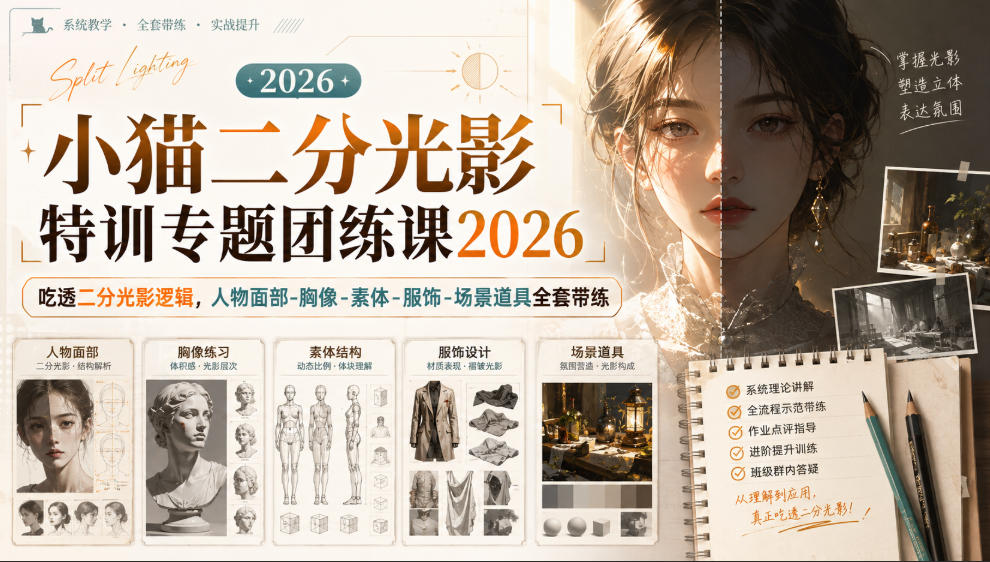
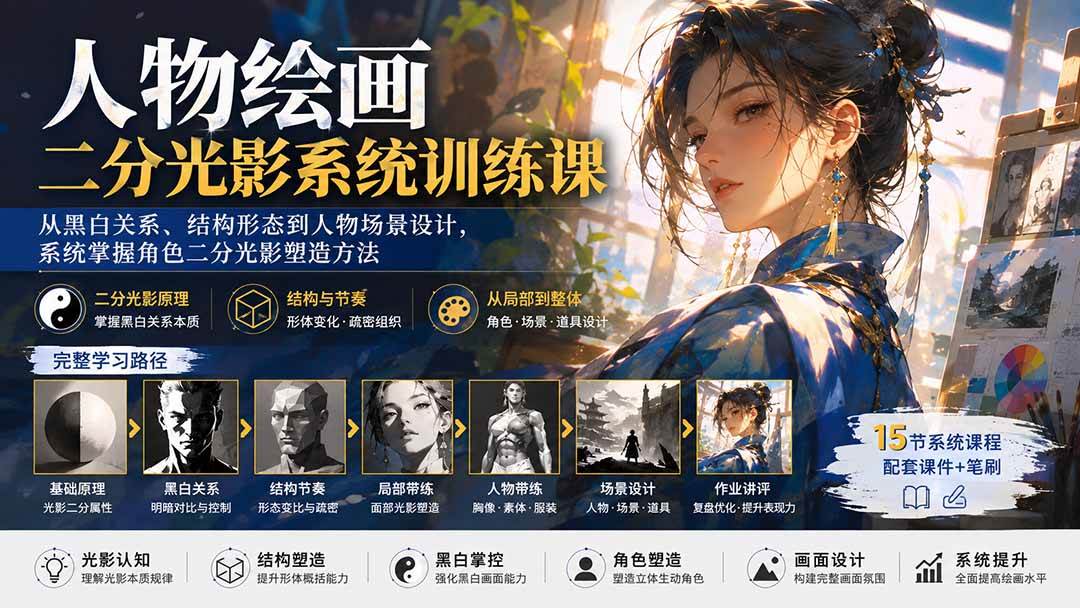
Figure-drawing two-tone light-and-shadow systematic training: from black-white relations and structure to character-scene design


High-value IP full-domain practice course: IP positioning and persona setup, product design, editing and private-domain monetization - a full landing course
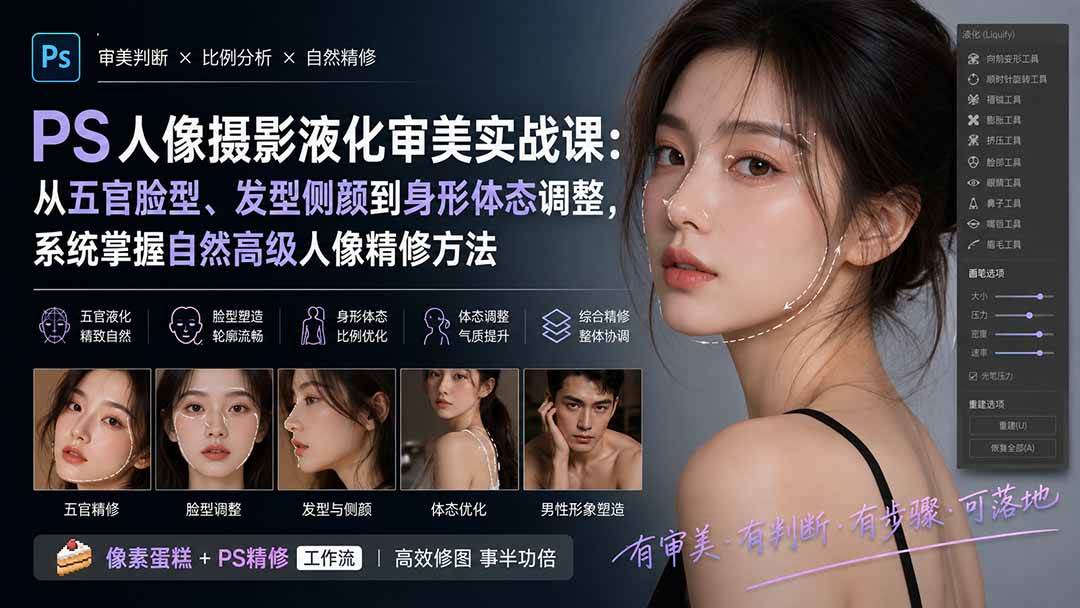

PS portrait retouching and liquify course: reject ineffective retouching, hands-on and easy to understand
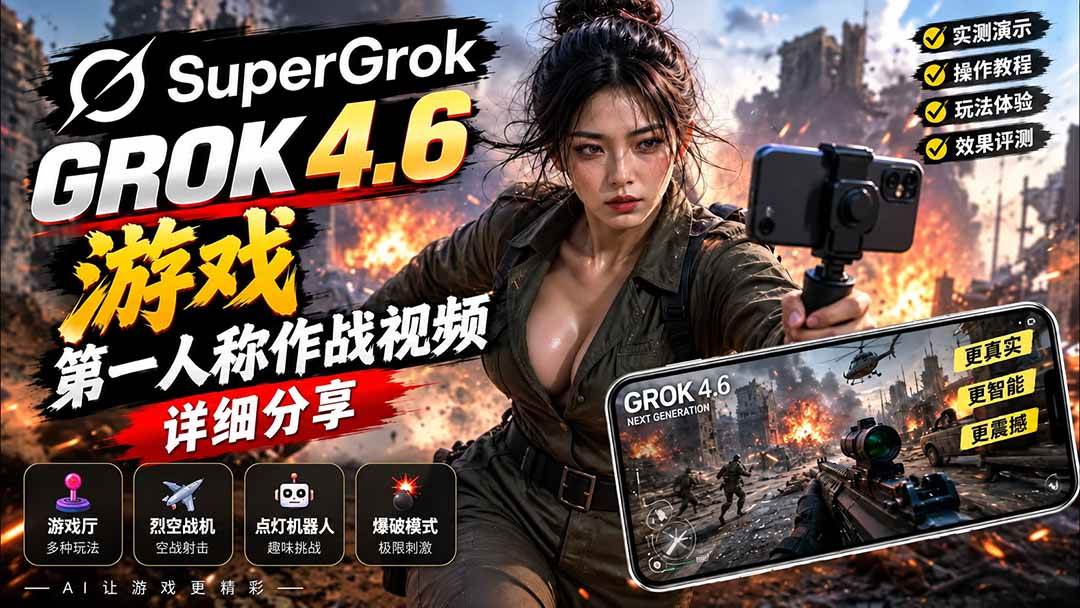
Can Grok 4.6 make games too? First-person combat video hands-on test, detailed gameplay walkthrough
QuAi 14-day Lu Dami online workshop: your personal brand deserves to be loved
