


-
Solo Business Courses
-
 Others
-
Overseas Tutorials
-
Photography & Editing
-
Community & Private Domain
-
Self-Media Writing & Copywriting
-
Side Income Projects
-
E-commerce
-
Short Video & Live Streaming
-
Artificial Intelligence (AI)
-
Software & Tools
-
Operating Systems
-
Plugins & Scripts
-
MacOS Software
-
Android Software
-
Windows Software

Jianying Mastery: The Complete Editing Handbook
-
Game Gold-Farming Money-Making Plan: Earn 1k+ Daily, a Stable 3-Year Project Anyone Can Do in Spare Time [Revealed]
Study material — included with membership Get Membership -
Hot-game fully-automated earning: 500+ a day, no experience, simple operation - the steadiest long-term game-earning side hustle (revealed)
Study material — included with membership Get Membership -
FlyingMouse earns merit this time! Don't panic at Windows format problems — the open-source FlyingMouse format conversion tool helps, a popular GitHub gem
Study material — included with membership Get Membership -
Douyin Product-Selling Coaching Bootcamp: No On-Camera Appearance Needed, Newbies Can Produce Selling Short Videos by Following the Steps
Study material — included with membership Get Membership -
First-release game gold-farming money plan: 1K+ a day, ordinary people in spare time
Study material — included with membership Get Membership






-
FlyingMouse earns merit this time! Don't panic at Windows format problems — the open-source FlyingMouse format conversion tool helps, a popular GitHub gem
Study material — included with membership Get Membership -
LuDaShi v6.1024.4105.1121 Slim Single File
Study material — included with membership Get Membership -
2D Cartoon Animation Software Moho Pro v14.3
Study material — included with membership Get Membership -
Video Editor Aiseesoft Filmai v1.0.18
Study material — included with membership Get Membership -
To-Do Microsoft To Do v2.147 Free
Study material — included with membership Get Membership -
PR/AE/DaVinci/FCPX video Plugin Nobe OmniScope Win1.11.15 / Mac1.10.138
Study material — included with membership Get Membership





Course Overview:
\Lesson 1: The Art of Color Grading
\How to color-grade footage to make it more vivid.
\Lesson 1: The Secrets Behind Stabilized Footage
\Why stabilization matters and how to achieve it.
\Lesson 1: Advanced Editing — Motion Inertia
\Deep-dive into motion inertia to sharpen editing.
\Lesson 1: Choosing the Right Resolution
\Finding the best resolution for shooting.
\Lesson 1: The Secrets of Shot Groups
\What shot groups are and how to use them in video.
\Lesson 1: Exploring the World of Montage
\The meaning of montage for developing an editor's mindset.
\Lesson 2: Matching Sound Effects to Footage
\Using sound effects correctly and avoiding motion-inertia mistakes.
\Lesson 2: Footage in Harmony with Music
\Matching footage and music for an audio-visual feast.
\Lesson 2: Fixed-Camera Shooting Tips
\Fixed-camera shooting for quality videos.
\Lesson 2: Golden Rules of Shot Design
\Shot-design principles to guide short-film positioning.
\Lesson 2: The Charm and Techniques of Slow Motion
\The visual principles of slow motion and how to use them.
\Lesson 2: Organizing Footage & Editing Basics
\Organizing footage and basic editing for a solid foundation.
\Lesson 3: Choosing Cut Points
\Tips for choosing cut points to edit faster.
\Lesson 3: Applying Slow Motion
\Using slow motion to add drama.
\Lesson 3: Secrets of the Storyboard
\Writing storyboards to improve storytelling.
\Lesson 3: Less Is More
\The less-is-more mindset for concise, refined work.
\Lesson 3: Music and Footage in Perfect Sync
\Matching music and footage for more emotional impact.
\Lesson 3: Volume Adjustment & Adding SFX
\Tuning volume and adding SFX to enrich video expression.
\Lesson 4: The 55-Rule Editing Technique
\Applying the 55 rule to improve editing.
\Lesson 4: Demo of Your First Film
\Demo of editing your first film to build practical skill.
\Lesson 4: Storyboard-Writing Tips
\Storyboard-writing tips for video creation.
\Lesson 4: Mastering Shooting Fundamentals
\Lesson 4: Mastering Shooting Basics
\Lesson 4: Mobile Camera Settings
\Mobile shooting parameter settings for quality.
\Lesson 4: Time-Lapse Footage & Adding Text
\Handling time-lapse and adding text for fun.
\Lesson 5: Applying Dissolve Transitions
\Using dissolves for smoother transitions.
\Lesson 5: Backward Script Practice
\Backward scripting to spark creative inspiration.
\Lesson 5: Adding Titles & Subtitles
\Adding titles and subtitles to improve information delivery.
\Lesson 5: Speed-Change Techniques
\Speed-change techniques for variety.
\Lesson 5: Editing Thinking Before Shooting
\Thinking about editing before shooting for innovation.
\Lesson 5: Time-Lapse Charm & Application
\Time-lapse principles and use cases.
\Lesson 6: Raising Video Aesthetics
\Tips to raise video aesthetics and attract viewers.
\Lesson 6: Applying Jump Cuts
\Using jump cuts for rhythm and visual punch.
\Lesson 6: Drawing Inspiration from Others' Videos
\Drawing inspiration from others to expand creative range.
\Lesson 6: Exposure & Focus Lock
\Locking exposure and focus for quality footage.
\Lesson 6: Don't Overuse Dissolves
\Why beginners shouldn't overuse dissolves, and restraint.
\Lesson 7: Matching Editing Techniques
\Applying techniques appropriately for overall quality.
\Lesson 7: Basic Shooting Homework
\Requirements for basic shooting homework.
\Lesson 7: Avoid Zooming In While Shooting
\Why avoid zooming in while shooting, for greater professionalism
Related Courses


Figure-drawing two-tone light-and-shadow systematic training: from black-white relations and structure to character-scene design




High-value IP full-domain practice course: IP positioning and persona setup, product design, editing and private-domain monetization - a full landing course
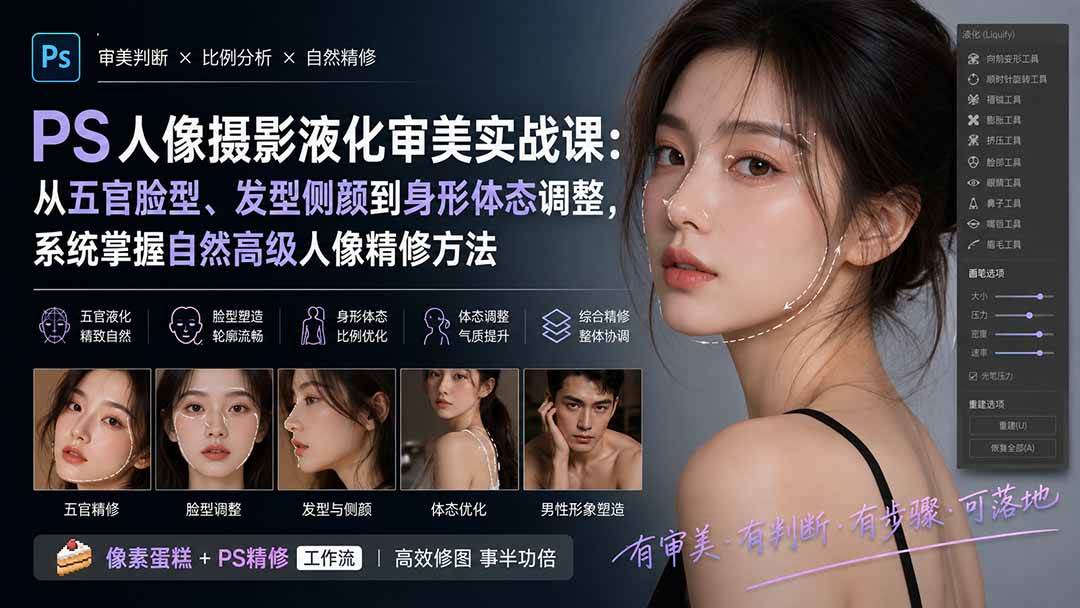

PS portrait retouching and liquify course: reject ineffective retouching, hands-on and easy to understand

Can Grok 4.6 make games too? First-person combat video hands-on test, detailed gameplay walkthrough

QuAi 14-day Lu Dami online workshop: your personal brand deserves to be loved
