-
Solo Business Courses
-
 Others
-
Overseas Tutorials
-
Photography & Editing
-
Community & Private Domain
-
Self-Media Writing & Copywriting
-
Side Income Projects
-
E-commerce
-
Short Video & Live Streaming
-
Artificial Intelligence (AI)
-
Software & Tools
-
Operating Systems
-
Plugins & Scripts
-
MacOS Software
-
Android Software
-
Windows Software

Foreign Trade B2B and Cross-Border E-commerce Product Selection Growth Bootcamp: Master the Full Process from Going Global with Selection to Business Implementation
-
Game Gold-Farming Money-Making Plan: Earn 1k+ Daily, a Stable 3-Year Project Anyone Can Do in Spare Time [Revealed]
Study material — included with membership Get Membership -
Hot-game fully-automated earning: 500+ a day, no experience, simple operation - the steadiest long-term game-earning side hustle (revealed)
Study material — included with membership Get Membership -
FlyingMouse earns merit this time! Don't panic at Windows format problems — the open-source FlyingMouse format conversion tool helps, a popular GitHub gem
Study material — included with membership Get Membership -
Douyin Product-Selling Coaching Bootcamp: No On-Camera Appearance Needed, Newbies Can Produce Selling Short Videos by Following the Steps
Study material — included with membership Get Membership -
First-release game gold-farming money plan: 1K+ a day, ordinary people in spare time
Study material — included with membership Get Membership






-
FlyingMouse earns merit this time! Don't panic at Windows format problems — the open-source FlyingMouse format conversion tool helps, a popular GitHub gem
Study material — included with membership Get Membership -
LuDaShi v6.1024.4105.1121 Slim Single File
Study material — included with membership Get Membership -
2D Cartoon Animation Software Moho Pro v14.3
Study material — included with membership Get Membership -
Video Editor Aiseesoft Filmai v1.0.18
Study material — included with membership Get Membership -
To-Do Microsoft To Do v2.147 Free
Study material — included with membership Get Membership -
PR/AE/DaVinci/FCPX video Plugin Nobe OmniScope Win1.11.15 / Mac1.10.138
Study material — included with membership Get Membership



This course is a hands-on program in foreign trade B2B and cross-border e-commerce market opportunity analysis and product selection, built for foreign trade entrepreneurs, cross-border e-commerce beginners, traditional B2B companies, small and mid-sized sellers, and anyone planning to enter overseas markets. The course has 27 lessons. It starts with global trade market analysis and centers on scientific product selection, industry competitiveness assessment and business implementation, systematically explaining the business logic, market opportunities, industry profits, blue-ocean product screening and executable going-global strategies for small and mid-sized sellers, from traditional foreign trade B2B to cross-border e-commerce B2C. When many people enter the foreign trade and cross-border e-commerce industry, the problems they hit most easily are: not knowing what product to sell, not knowing which countries have demand, not knowing whether an industry is actually profitable, and being unable to tell whether a hot track is a real growth opportunity or a fiercely competitive red ocean. This course takes you out of blindly following trends in product selection. Through three-dimensional data analysis, corporate survival rates, RCA revealed comparative advantage, global market size, Porter's Five Forces, the industrial value chain, inventory cycles and national prosperity indices, you will gradually build a more systematic system for judging overseas markets and screening products. The course not only helps students understand the core differences between the two business models, B2B and B2C, but also analyzes in depth the profit distribution upstream and downstream of the industrial chain, the development stage of different national markets, and the difference between shrinking existing markets and incremental dividend markets, helping students find worthwhile niche opportunities in the data. Finally, combined with the needs of real business implementation, it focuses on startup costs, industry entry barriers, the characteristics of blue-ocean and red-ocean tracks, and operating tactics suitable for small and mid-sized sellers, so that students can not only analyze the market but also learn to formulate more reasonable cross-border entry plans based on their own resources and capital. From understanding the global market to mastering scientific product selection, then to evaluating profit space and real implementation, it makes foreign trade and cross-border e-commerce entrepreneurship no longer a matter of pure instinct, but about learning to use data and business logic to find opportunities. 1. 27 lessons of systematic teaching to build a complete product-selection mindset From basic concepts to market analysis, from industry competitiveness to business implementation, this helps students build a relatively complete research system for foreign trade and cross-border e-commerce opportunities. 2. Data-driven product selection to reduce blind trend-following Products are analyzed through data dimensions such as RCA, global market size and corporate survival rates, making product selection decisions better grounded. 3. Dual analysis with Porter's Five Forces and the value chain You learn not only whether a product can be sold, but also how to judge industry competitive structure, upstream and downstream profit distribution and potential profit space. 4. Systematic screening of blue-ocean and red-ocean tracks Combined with a five-step SOP for screening hot tracks, this helps students master methods for identifying different competitive environments. 5. Combining global markets with national economic cycles From market tiering and inventory cycles to national prosperity, this helps students understand the growth conditions of different overseas markets. 6. Dual-mode comparison of B2B and B2C A full understanding of the differences between traditional foreign trade and cross-border e-commerce in business process, cost investment and operational requirements, avoiding blind choices. 7. Focus on real implementation for small and mid-sized sellers Emphasis on startup capital, entry barriers and executable tactics, making the course content closer to the real needs of individual entrepreneurs and small and mid-sized companies. 1. Foreign trade beginners: people who want to enter the international trade industry but don't know how to choose products and target markets. 2. Cross-border e-commerce beginners: people who want to establish scientific product selection methods and avoid blindly following hot products. 3. Traditional B2B foreign trade companies: business owners who want to understand the cross-border e-commerce B2C model and explore new overseas sales channels. 4. Factory and supply chain managers: people who want to analyze overseas market demand and export opportunities based on their own product strengths. 5. Small and mid-sized cross-border sellers: people who want to find niche tracks through data analysis and optimize product layout. 6. Cross-border e-commerce operators: people who want to improve their ability in industry analysis, market research and product competitiveness assessment. 7. Individual entrepreneurs and freelancers: people who want to understand low-cost cross-border going-global opportunities and evaluate the business model that suits them. What will you gain after completing the course? Through systematic study of 27 lessons, you will gradually master the core business logic of foreign trade B2B and cross-border e-commerce B2C, and build a complete product-selection thinking path from global market analysis, product competitiveness research and industry profit assessment to blue-ocean track screening. You will learn to use methods such as RCA indicators, Porter's Five Forces, value chain analysis and global market tiering to assess a product's competitive environment and market opportunities, and understand how to combine national prosperity, industry cycles and entry barriers to judge whether a cross-border business direction deserves deeper research. At the same time, you will also understand the startup costs and resource requirements of different business models, learn market entry thinking suitable for small and mid-sized sellers, and build a clearer decision framework for actually carrying out foreign trade or cross-border e-commerce business. From traditional foreign trade B2B to cross-border e-commerce B2C, from global market research to blue-ocean product mining, 27 lessons take you to systematically master data-driven product selection, industry profit analysis and the business implementation methods of going global, saving you detours in product selection and helping you find overseas market opportunities that suit you better. 01. Opening remarks, Foreign Trade B2B & Cross-Border E-commerce Opportunity Analysis Report 02. Preface. Table of contents explanation (product selection logic system) 03. Is foreign trade easy to do? 04. Core differences and applicable scenarios of B2B & B2C 05. Three-dimensional data analysis and corporate survival rates 06. National top-level favorable policies 07. The underlying tone of RCA product competitiveness 08. Foreign trade product selection logic 09. Global market size 10. Which products are not fiercely contested 11. What is the industrial chain 12. How much is the industry profit (Porter's 5 Forces) 13. Which products make money (value chain) 14. Five-step SOP for screening hot tracks 15. Global market tiering 17. Shrinking existing markets VS incremental dividend markets 18. Global inventory cycles 19. Prosperity of segmented countries 20. Foreign trade B2B & B2C practical guide 21. Startup costs of B2B & B2C 22. Blue-ocean track products 23. Red-ocean track products 25. Tactics small and mid-sized sellers can implement 26. A chat about other implementation insights 27. The End, Thanks and summary
Supporting Study Materials
This course comes with a materials pack. Members receive the access link by email after requesting the course.
Related Courses


Latest e-commerce techniques shared daily 2025-2026 to help your store avoid detours and do better (updated Aug 2026)

Hands-on E-commerce Price-Testing Course: Tiered Price Testing, Traffic-Conversion Judgment, Finding the Profit-Sales Balance Point
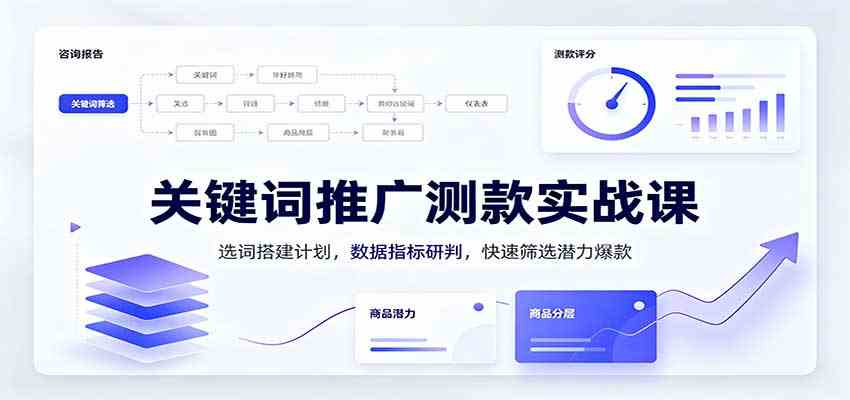
Hands-on Keyword Promotion Product-Testing Course: Keyword Selection & Campaign Setup, Metric Analysis, Fast Screening of Potential Hits

Tmall/Taobao high-profit growth class, Hangzhou offline session 31 (Aug 22-24): grow sales and profit over three days

A Side Hustle Anyone Can Land With Zero Basis: Build Pinduoduo Virtual-Category Passive Income, Add 10-30k Monthly

Taobao e-commerce breakthrough bootcamp: 2026 platform new-rule teardown, traffic-conversion logic, and a hands-on merchant guide
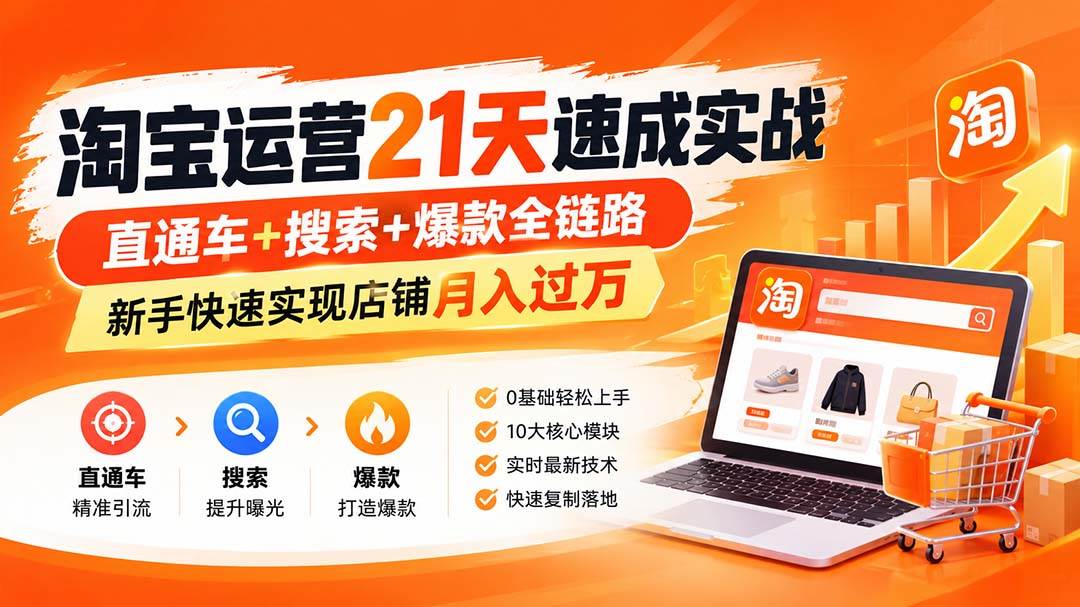
Taobao operations 21-day crash course (updated Aug): through-train + search + viral full chain, beginners reaching 10K+ monthly store income fast

Pinduoduo systematic operations course (updated Aug): from zero store setup to viral replication, stable 1000 orders/day and 50K+ monthly profit